2026 Housing Market Split: Starter Homes vs. Luxury
Aug 13, 2026
Written by Discount Property Investor Team
The U.S. housing market is no longer moving as one market.
In 2026, the gap between entry-level and luxury housing has become impossible to ignore. Starter homes are seeing more available inventory, more price reductions, and fewer sales. At the same time, luxury homes continue to attract buyers, particularly in high-income markets where cash purchases, investment gains, and financial flexibility are helping buyers move forward.
According to Zillow’s July 2026 analysis, starter-home inventory increased 4.5% year over year in June, yet starter-home sales declined 5.4% in May. Luxury inventory moved in the opposite direction, falling 5.2%, while luxury sales rose 6.2% over the same period. Zillow’s 2026 housing analysis describes the result as a market splitting into two very different segments.
For first-time buyers, this sounds like bad news at first. However, there is an important opportunity hidden inside the slowdown: starter-home buyers have more negotiating leverage than they have had in years.
The challenge is that buyers must still qualify for the home, manage higher monthly ownership costs, and make careful decisions about price, inspections, financing, and future resale value. More listings do not automatically mean homes are affordable. In many cases, buyers have more choices because the financial hurdles are keeping other buyers on the sidelines.
That is the central story of the 2026 housing market: starter homes are becoming easier to negotiate, but not necessarily easier to afford.
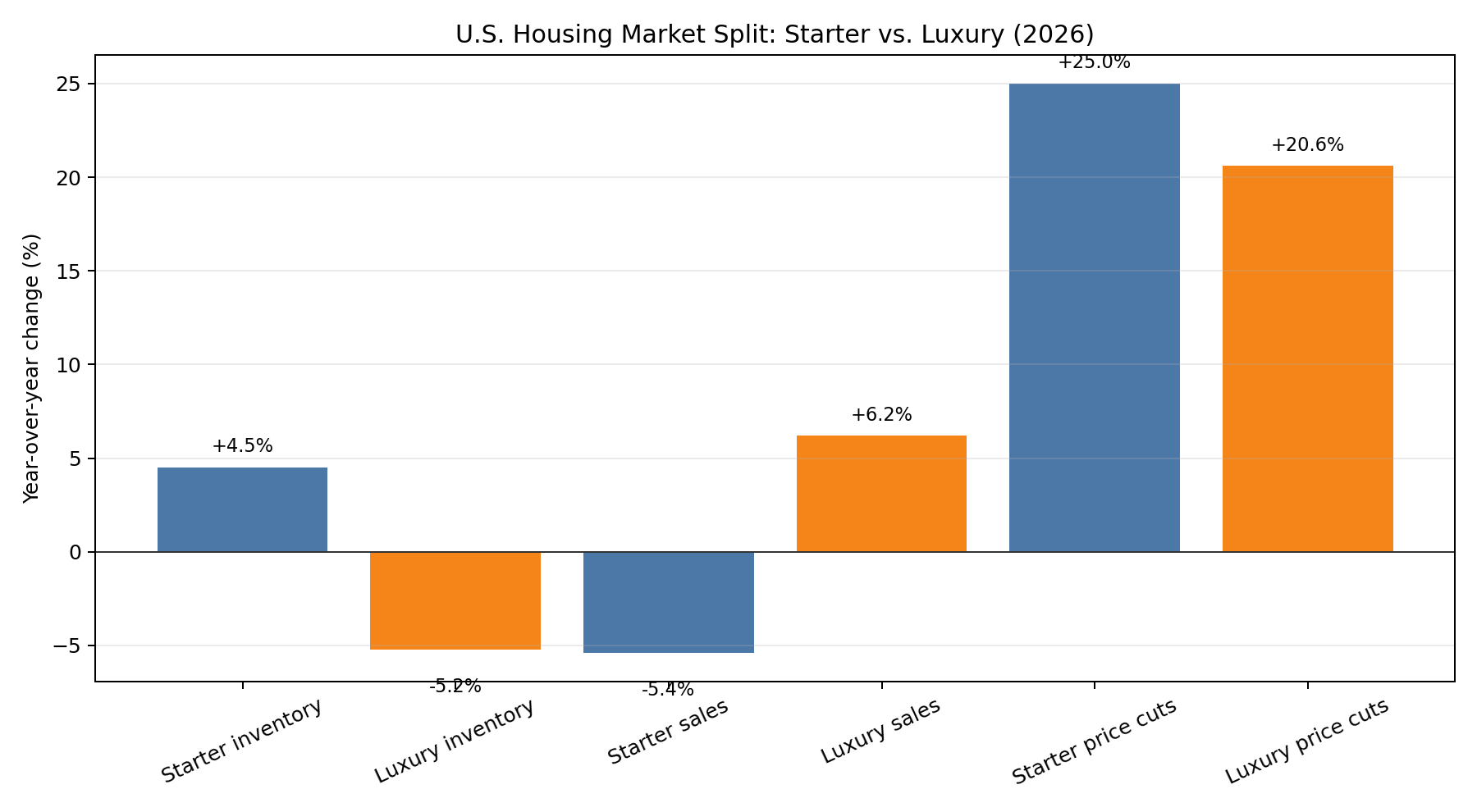
Data source: Zillow, July 2026. The graph compares year-over-year changes in inventory, sales, and price reductions.
The numbers behind the divide
The difference between the two housing segments is visible across nearly every major market indicator.
Zillow defines starter homes as properties generally located between the fifth and thirty-fifth percentiles of local home values. Nationally, the typical starter home was worth approximately $202,000 in May 2026, an increase of 2.3% from the previous year. Luxury homes, defined as properties in the top 5% of local values, had a typical national value of approximately $1.9 million, up 3.1% year over year. Zillow reported these price-tier definitions and values in its 2026 study.
The differences become clearer when looking at inventory and sales:
|
Market Indicator |
Starter Homes |
Luxury Homes |
|---|---|---|
|
Inventory change, year over year |
+4.5% |
-5.2% |
|
Sales change, year over year |
-5.4% |
+6.2% |
|
Listings with price cuts |
25.0% |
20.6% |
|
Typical national value |
$202,000 |
Approximately $1.9 million |
The starter-home market is receiving more supply, but buyers are not absorbing that supply at the same rate. Luxury homes, meanwhile, are becoming relatively scarcer while sales are increasing.
This does not mean every luxury home is selling immediately or every starter home is sitting untouched. Real estate is always local. A well-priced starter home in a desirable neighborhood can still receive multiple offers, while an overpriced luxury property can remain listed for months. The national pattern is useful, but buyers and sellers still need to examine their individual city, neighborhood, property type, and price range.
Even so, the national data reveals a major shift in bargaining power. A first-time buyer who is shopping carefully may find less competition, more price reductions, and sellers who are more open to concessions than they were during the intense bidding wars of the early 2020s.
Why starter homes are sitting
The simplest explanation is affordability.
A starter home may be less expensive than the average home, but the buyer still has to qualify for the mortgage, pay property taxes and insurance, maintain the home, and handle the other costs that come with ownership. The monthly payment has become the main obstacle for many households—not simply the listing price.
As of August 2026, mortgage rates remain close to 7%. CNBC reported that the average 30-year fixed mortgage rate was 6.75% in early August. That rate is significantly higher than the rates many homeowners locked in before 2022. CNBC’s August 2026 report explains how mortgage rates and household expenses are affecting starter-home demand.
Consider a $202,000 mortgage before taxes, insurance, mortgage insurance, homeowners association dues, repairs, and other expenses. At a 6.75% interest rate, the principal-and-interest payment is roughly $1,310 per month. At 5%, the same loan would be approximately $1,084 per month. That difference of about $226 each month can be the difference between qualifying and not qualifying.
The financial pressure does not stop at the mortgage payment. Buyers are also dealing with:
-
Higher homeowners insurance premiums.
-
Rising property taxes in many areas.
-
Increased costs for utilities, repairs, and contractor services.
-
Student loan payments and other consumer debt.
-
Childcare and transportation expenses.
-
Down-payment requirements and closing costs.
-
Uncertainty about employment and future income.
This explains why more listings have not automatically created a surge in starter-home sales. A buyer may find a home that appears affordable on paper but still decide that the full monthly cost is too risky.
A market can therefore become more favorable for buyers while remaining financially difficult. That is exactly what is happening at the entry level in 2026.
The luxury market has different rules
Luxury buyers are not completely immune to higher mortgage rates, but many are less dependent on mortgage financing.
Some high-income households can purchase with cash, borrow against investment accounts, sell assets, or make a large down payment. That gives them more flexibility than a first-time buyer who is relying on a mortgage for nearly the entire purchase.
Realtor.com’s 2026 luxury outlook found that cash purchases become increasingly common as prices rise. In Miami, cash transactions represented 46.5% of purchases between $1 million and $2 million, 64.4% of purchases between $2 million and $5 million, and 84.7% of purchases between $5 million and $10 million. Realtor.com’s 2026 luxury-market report provides the cash-purchase data and explains why high-end buyers are less exposed to mortgage-rate changes.
This financial flexibility changes the way luxury buyers respond to the market. A buyer with substantial liquid assets may focus more on location, privacy, architecture, amenities, or long-term investment value than on whether the mortgage rate moves from 6.5% to 7%.
Luxury demand is also supported by wealth concentration. Buyers with significant stock-market gains, business income, or existing real estate equity may have more purchasing power than households trying to save their first down payment.
That does not mean the luxury market is universally strong. Luxury properties can still be overpriced, difficult to insure, or limited to a small buyer pool. However, the segment is less dependent on the typical first-time-buyer mortgage calculation.
Realtor.com reported that the national entry point for luxury listings was near $1.2 million in early 2026. The top 1% of the market remained several million dollars higher, while the most exclusive segment showed renewed momentum. The luxury market has entered a period of normalization rather than a complete collapse. The report’s 2026 outlook shows how luxury housing has stabilized while remaining concentrated in high-wealth markets.
The K-shaped housing market
Economists often use the term “K-shaped economy” to describe a situation in which different groups experience very different financial outcomes at the same time.
One side of the K moves upward. Higher-income households may benefit from strong investment portfolios, business ownership, rising property values, and access to cash. The other side moves downward or remains under pressure as households deal with rising expenses, limited savings, and higher borrowing costs.
The housing market is reflecting this split.
For higher-income buyers, a home purchase may be supported by accumulated wealth. For first-time buyers, the purchase often depends on wages, credit scores, savings, and the ability to absorb a large monthly payment.
The result is a market where luxury sales can rise while starter-home sales decline. That may seem contradictory, but the two groups are responding to different financial conditions.
Zillow’s data shows the difference clearly: luxury sales rose 6.2% year over year in May, while starter-home sales fell 5.4%. Luxury inventory declined 5.2% in June, while starter inventory rose 4.5%. The underlying Zillow figures demonstrate how supply and demand have moved in opposite directions by price tier.
The market is not simply “hot” or “cold.” It is hot for some buyers, slow for others, and highly dependent on the price range.
What the slowdown means for first-time buyers
The decline in starter-home sales is frustrating, but it creates several advantages for buyers who are financially prepared.
During a seller’s market, buyers often have to waive inspections, offer above asking price, and make quick decisions. In the current environment, many buyers have more time to evaluate the property and negotiate terms.
That does not mean buyers should make reckless offers. It means they can approach the process with more discipline.
A slower listing may provide an opportunity to negotiate:
-
A lower purchase price.
-
A seller-paid closing-cost credit.
-
A mortgage-rate buydown.
-
Repairs identified during inspection.
-
A home warranty.
-
Appliances or other personal property.
-
Flexible closing or possession terms.
-
A credit for insurance, roofing, or mechanical work.
The best negotiation is usually based on evidence. A buyer should not simply tell the seller that the home is overpriced. The buyer’s agent should compare the property with recent sales, current competing listings, price reductions, condition, location, and time on market.
If the listing has been available for 45, 60, or 90 days, the seller may be more willing to negotiate. However, time alone does not guarantee a discount. Some sellers have unrealistic expectations, while others may be testing the market and have no urgent need to sell.
The goal is to identify a seller who has both a property that fits the buyer’s needs and a reason to make a deal.
How to find a starter home that is ready for negotiation
There is no universal number of days that automatically makes a home a bargain. A property that has been listed for two weeks in one neighborhood may be considered slow, while a luxury or rural property may regularly take several months to sell.
Still, buyers can use a practical screening process.
1. Track the original list price
Look at the property’s original price, current price, and any previous reductions. A home that has already had one price cut may be entering a negotiation phase. A home with multiple reductions may have a seller who is becoming more realistic—or a property with a serious problem.
The difference matters. A price reduction can signal opportunity, but it can also signal poor condition, an undesirable location, or a difficult inspection history.
2. Compare the listing with recent sales
Recent comparable sales are more useful than active listings because closed sales show what buyers actually paid. Compare:
-
Square footage.
-
Number of bedrooms and bathrooms.
-
Lot size.
-
Year built.
-
Renovations.
-
Parking.
-
School boundaries, where relevant.
-
Monthly association fees.
-
Condition and deferred maintenance.
If the home is priced above similar properties without a clear reason, the buyer may have room to negotiate.
3. Watch for repeated price cuts
One price reduction may be normal. Several reductions over a short period deserve closer attention.
For example, imagine a starter home listed at $275,000, reduced to $265,000 after three weeks, and then reduced to $255,000 after another month. That history tells a buyer that the seller has already received feedback from the market. The buyer may be able to negotiate further, particularly if the property has inspection concerns or remains overpriced compared with recent sales.
4. Review the property condition
A lower price does not necessarily mean a better deal if the home needs a roof, electrical work, plumbing repairs, foundation work, or major heating and cooling replacement.
A buyer should estimate repair costs before making an offer. Contractors may not provide a detailed quote during a short inspection period, but even a preliminary estimate can prevent the buyer from overpaying.
A $10,000 discount may not be meaningful if the home requires $30,000 in immediate repairs.
5. Ask why the seller is moving
The seller’s motivation can influence the negotiation. Relocation, a job change, an already-purchased replacement home, an estate sale, or a pending deadline may create more flexibility.
A seller who has no timeline and substantial equity may be less willing to compromise, even if the home has been on the market for months.
6. Look beyond the asking price
The purchase price is only one part of the offer. A seller may reject a lower price but accept an offer with a faster closing, fewer contingencies, or a larger earnest-money deposit. Buyers should work with their agent to structure an offer that addresses the seller’s priorities without exposing the buyer to unnecessary risk.
Builder concessions are one of the smartest opportunities
New-construction starter homes deserve special attention in 2026.
Builders generally do not like to reduce published prices aggressively because visible price cuts can affect the perceived value of an entire community. If one home is sold at a much lower price, future buyers may expect the same discount.
Instead, builders often prefer incentives. These may include:
-
Closing-cost assistance.
-
Temporary mortgage-rate buydowns.
-
Upgraded appliances.
-
Flooring or cabinet upgrades.
-
Free lot premiums.
-
Included blinds or landscaping.
-
HOA-fee credits.
-
Special financing through the builder’s preferred lender.
-
Contributions toward prepaid taxes or insurance.
For a buyer, a concession can be more valuable than a small price reduction.
Suppose a builder offers a $10,000 closing-cost credit. That money might reduce the buyer’s cash needed at closing or help fund a temporary interest-rate buydown. A $10,000 reduction in the purchase price, by comparison, may produce only a modest monthly payment difference.
The exact value depends on the loan type, interest rate, credit requirements, and lender rules. Buyers should compare the builder’s preferred financing with outside lenders rather than automatically accepting the incentive.
A builder’s incentive may come with conditions. The buyer might need to use a specific lender, close by a certain date, or purchase a particular inventory home. The advertised rate could also depend on discount points or other fees.
The best strategy is to compare the total cost:
-
Purchase price.
-
Interest rate.
-
Loan fees.
-
Closing costs.
-
Monthly payment.
-
Property taxes and insurance.
-
HOA fees.
-
Builder warranty.
-
Expected repair and maintenance costs.
A new-construction home may offer lower immediate maintenance expenses, but buyers should still understand the warranty, construction timeline, inspection process, and neighborhood completion schedule.
A buyer can also request an independent inspection. New construction is not automatically free of defects. An inspection before closing may identify incomplete work, drainage concerns, installation issues, or items that need correction.
Why the starter-home shortage still matters
It would be a mistake to interpret the current increase in starter-home inventory as a complete return to affordability.
Realtor.com reported in July 2026 that the number of homes priced under $350,000 had improved from the 2022 trough, but the country still had approximately 300,000 fewer affordable listings than before the pandemic. The typical starter home had risen from $256,000 in 2019 to $344,000 in 2026 under Realtor.com’s broader starter-home measure. Realtor.com’s starter-home report explains why inventory has improved while affordability remains historically strained.
That distinction is crucial.
The market can have more starter homes than it did last year and still have far fewer affordable homes than it had before the pandemic. Buyers may be seeing more listings because demand has weakened, not because prices have returned to a comfortable level.
The income required to buy has also increased much faster than household income in many areas. Realtor.com found that the income needed to purchase a typical starter home had risen more than 80% since 2019, while median household income had increased by approximately 28.3% over the same period. The 2026 Realtor.com analysis documents the widening gap between housing costs and household income.
This is why many buyers feel confused. They may see a listing price that looks lower than the national median and still find the monthly payment difficult to manage.
Regional differences matter
National data is useful for identifying broad trends, but the real opportunity depends on the local market.
The South has shown one of the more encouraging starter-home stories. New construction in Texas, Florida, and the Carolinas has added more affordable listings than many other regions. Realtor.com reported that the South had gained nearly 170,000 more lower-priced listings compared with the pandemic-era trough. The regional analysis from Realtor.com describes how new construction has improved entry-level supply in parts of the South.
However, more supply does not guarantee strong affordability in every Southern city. Insurance costs, property taxes, HOA fees, and rapid population growth can still create significant monthly expenses.
The West is more divided. Some markets, including parts of Arizona, Colorado, and Nevada, have experienced price moderation from their pandemic peaks. Coastal California remains much more difficult because land costs, construction restrictions, and high baseline prices continue to limit entry-level supply.
The Northeast remains one of the most challenging regions for first-time buyers. Starter-home prices are significantly higher than pre-pandemic levels, while new construction and available land remain limited.
The Midwest remains relatively affordable compared with other regions, but its advantage is narrowing. Demand from buyers relocating from more expensive markets has put pressure on starter-home prices in several Midwestern cities.
For buyers willing to relocate, regional differences can create opportunities. A household may find better negotiating conditions in a market with new construction, higher inventory, and more price reductions than in a market where affordable homes remain extremely scarce.
A practical negotiating example
Consider a hypothetical starter home listed at $265,000.
The property has been on the market for 72 days. It originally listed at $285,000 and has already received one price reduction. Recent comparable homes have sold between $245,000 and $255,000, but this property has a newer roof and updated electrical work.
A buyer might decide that the home’s fair value is approximately $255,000. Instead of simply offering $240,000 without explanation, the buyer could submit:
-
Purchase price: $250,000.
-
Request for $7,500 in seller-paid closing costs.
-
Standard inspection contingency.
-
Appraisal contingency.
-
Financing contingency.
-
Closing date that matches the seller’s preferred timeline.
The seller may reject the full request but counter at $255,000 with $5,000 in closing-cost assistance. Depending on the buyer’s loan and cash position, that concession could be more helpful than a lower price alone.
The important point is that negotiation should be based on the property’s market position and the buyer’s financial plan. A buyer should not stretch beyond a comfortable payment simply because the seller offers a concession.
What sellers should understand
The split market also changes the strategy for starter-home sellers.
In a slower segment, pricing accurately from the beginning is more important than testing an ambitious number. Buyers have more alternatives, and an overpriced listing can become stale quickly.
Sellers should pay attention to:
-
The number of competing listings.
-
Recent closed sales, not just asking prices.
-
The property’s condition.
-
The time it takes similar homes to receive an offer.
-
The percentage of local listings receiving price reductions.
-
Buyer feedback from showings.
-
Financing and insurance concerns.
A seller may be better off offering a concession at the beginning rather than waiting for several months and eventually making a larger price reduction.
For example, a $6,000 credit toward closing costs could help a buyer overcome an immediate cash requirement while preserving the seller’s headline price. Whether that is financially preferable depends on the seller’s net proceeds, the buyer’s loan program, and local rules.
The strategy should be reviewed with the listing agent and, when appropriate, a tax or financial professional.
What buyers should avoid
A slower market creates opportunities, but it also creates traps.
Buyers should avoid assuming that every price reduction represents a bargain. A home may be reduced because it was dramatically overpriced at the beginning. A buyer should still compare the property with recent sales.
Buyers should also avoid using the entire available budget. Lenders qualify borrowers using specific rules, but a lender’s maximum approval is not necessarily a comfortable monthly payment.
It is important to leave room for:
-
Emergency repairs.
-
Insurance increases.
-
Property-tax changes.
-
Appliance replacement.
-
Routine maintenance.
-
Furniture and moving expenses.
-
Job or income changes.
Buyers should be especially careful with new construction. Builder incentives can be attractive, but the buyer should compare the complete loan terms and understand whether the incentive is tied to a specific lender.
Finally, buyers should not waive important protections without understanding the consequences. Inspection, financing, and appraisal contingencies can be negotiated, but removing them can create substantial financial risk.
The rest of 2026
The housing market is unlikely to return to the bidding-war environment of the early pandemic years in every segment. Starter-home buyers are likely to continue seeing more listings and more opportunities to negotiate, particularly in markets where builders have added supply or demand has cooled.
However, a dramatic national price collapse is not the most likely outcome. Housing supply remains limited in many regions, and construction costs, insurance, taxes, and financing expenses continue to support high ownership costs.
The more realistic expectation is uneven normalization.
Some markets may become buyer-friendly quickly. Others may remain expensive because inventory is scarce. Luxury housing may continue to attract financially strong buyers even when first-time buyers remain cautious.
For a first-time buyer, the most important change is not that starter homes have suddenly become cheap. It is that the buyer may no longer have to compete as aggressively for every property.
That creates room to slow down, compare options, negotiate intelligently, and choose a home that fits the household’s actual budget.
The bottom line
The 2026 housing market is split by price tier.
Starter-home inventory is rising, sales are falling, and price reductions are more common. Luxury inventory is tighter, sales are stronger, and buyers are less affected by mortgage rates because many can use cash or existing wealth. Zillow’s data captures the divide: starter sales declined 5.4% while luxury sales increased 6.2% year over year. The complete Zillow report provides the latest national and metro-level comparisons.
For first-time buyers, the opportunity is real—but it requires preparation. The best deals may come from homes that have been sitting for several weeks, already experienced a price reduction, or need repairs that can be documented during negotiations.
New-construction buyers should focus on builder concessions, rate buydowns, closing-cost assistance, and upgrades instead of looking only for a lower sticker price.
At the same time, buyers should remember that more inventory does not eliminate the affordability problem. A home can be easier to negotiate and still be too expensive for a particular household.
The smartest approach in 2026 is to buy based on the total monthly cost, not the headline price. Compare the mortgage, taxes, insurance, HOA dues, repairs, and long-term maintenance. When the numbers work, the current market may offer something first-time buyers have not had in years: time and negotiating power.