Inventory Is Rising—Is Your Listing Ready to Stand Out?
Aug 14, 2026
Written by Discount Property Investor Team
The housing market is changing, and real estate agents need to change their listing presentations with it.
Inventory is gradually improving in several parts of the country, but the recovery is uneven. At the same time, buyers are still active, but they are more cautious about price, condition, monthly payments, and overall value.
That means sellers cannot rely on the strategy that worked during the pandemic housing boom. A “Coming Soon” sign and a few phone pictures may not produce fifteen offers over one weekend. In many markets, sellers need a clear pricing strategy, stronger preparation, professional marketing, and an agent who is willing to explain difficult realities.
The listing presentation for the second half of 2026 should answer one central question:
Is this home positioned well enough to compete for today’s buyer?
Inventory Is Improving Unevenly
The national housing market cannot be described accurately with one simple headline. Inventory is moving differently from one region to another.
According to HousingWire, active inventory stood at 830,939 homes for the week ending June 20, 2026, which was only 0.25% higher than the previous year. However, the regional results were very different: inventory increased 7.2% in the Northeast and 5.5% in the Midwest, while it declined 0.8% in the South and 2.8% in the West. HousingWire’s 2026 regional inventory report shows why agents should be careful when using national statistics to advise local sellers.
This regional difference matters during a listing presentation.
A seller in the Northeast may face more competition than last year. A seller in the South or West may still benefit from limited local supply. The national market provides a broad frame of reference, but local comparable sales, active listings, pending contracts, price reductions, and showing activity are more important when determining how to price one specific home.
Inventory may be growing, but that does not mean demand has disappeared.
In the same report, HousingWire found that pending sales were increasing year over year in all four major regions. Pending sales rose 4.1% in the Northeast, 9.0% in the Midwest, 6.9% in the South, and 8.4% in the West. The regional data also shows that buyers are still participating even as supply changes.
The better interpretation is that buyers still want homes, but they have become more selective.
Buyers Have More Choices
During the pandemic housing boom, buyers often felt that hesitation meant losing the property.
They made quick offers, competed against multiple buyers, waived contingencies, and sometimes paid significantly above the asking price. Sellers became accustomed to receiving immediate attention, strong terms, and multiple offers.
The market in 2026 requires a different mindset.
A buyer may now compare several homes before making an offer. They may evaluate the complete monthly payment instead of focusing only on the purchase price. They may ask for repairs, closing-cost assistance, or an interest-rate buydown. They may also wait for an overpriced home to reduce its price instead of making an aggressive offer immediately.
This creates a more competitive environment for sellers.
The home does not need to be perfect, but it needs to compare favorably with the other homes buyers can see. If a nearby property is cleaner, better photographed, more updated, or priced more realistically, buyers have a reason to choose that listing instead.
That is why the listing presentation needs to include more than a discussion about commission and marketing exposure. It needs to explain competition.
The 2026 Numbers Tell a Story
Realtor.com reported that active listings reached 1,102,615 in June 2026, up 1.9% from the previous year. New listings increased 2.4% year over year, while the national median list price declined 2.5% to $430,000. Realtor.com’s June 2026 housing report provides the full data on inventory, prices, and market time.
Realtor.com also reported that 18.8% of active listings experienced a price reduction during June. That number is important because it shows how many sellers had to adjust their expectations after the original price failed to attract enough buyer interest. The June report includes the national price-reduction figure and other market indicators.
This does not mean the market is collapsing. It means buyers are pushing back when a home is priced above its perceived value.
The national median time on market was 53 days in June, unchanged from June 2025. According to Realtor.com, that ended a 26-month period in which homes were taking longer to sell year over year. Realtor.com’s June 2026 report explains the change in the time-on-market trend.
The Federal Reserve Bank of St. Louis reported a national median of 57 days on market in July 2026, compared with 53 days in June and 52 days in both April and May. The FRED housing inventory series provides the monthly national median days-on-market observations through July 2026.
The lesson is straightforward: a home can still sell quickly, but the seller must give buyers a reason to act.
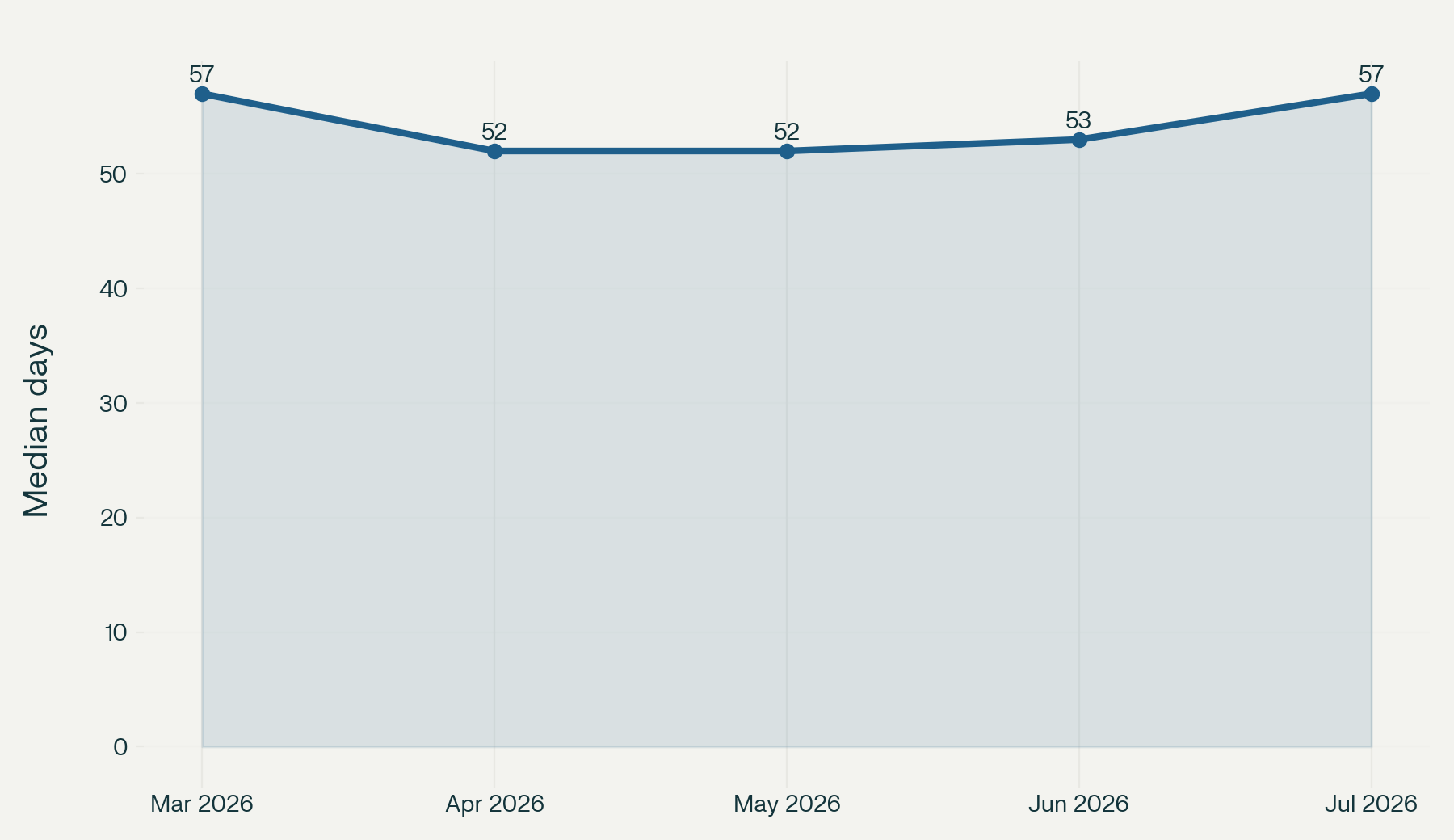
The graph uses the following national monthly observations: 57 days in March, 52 days in April, 52 days in May, 53 days in June, and 57 days in July. The underlying monthly observations are available on the Federal Reserve Bank of St. Louis data page
The increase from 52 days in May to 57 days in July does not tell an agent exactly how long a particular listing will take to sell. It does show why sellers should not assume that every properly marketed home will receive an offer immediately.
Market conditions can also change within the same year. A listing launched during one season may face different competition, interest rates, buyer behavior, and inventory levels several months later.
Agents should therefore use current local data rather than relying on last year’s results or a seller’s memory of the pandemic market.
Sellers Are Still Anchored to the Boom
Many sellers are still comparing today’s market to 2020 and 2021.
They remember when:
-
Homes sold within hours.
-
Buyers offered more than the asking price.
-
Multiple offers arrived during the first weekend.
-
Sellers waived repairs and contingencies.
-
Buyers competed emotionally.
-
A home could sell even if it needed work.
Those memories can influence how sellers think about their own property.
A homeowner may believe that a home purchased several years ago should automatically be listed at the highest price in the neighborhood. Another seller may point to a nearby property that received several offers during the pandemic and expect the same result today.
The agent’s job is not to dismiss those experiences. The agent’s job is to connect them to current evidence.
A useful way to explain the difference is:
“Your home may have appreciated, but buyers today have more choices and are paying closer attention to the monthly payment. Our goal is to price the home where the current market will respond—not where the market was several years ago.”
That conversation may feel uncomfortable, but it is better to have it before signing the listing than after the home has sat unsold.
Price the Home Before the Market Does
Pricing is the most important part of the listing strategy.
An agent who promises an inflated price may win the listing appointment, but that agent may lose credibility once the property receives little activity. Overpricing usually creates a chain reaction:
-
The home receives fewer online inquiries.
-
Showing activity is weaker.
-
Buyers provide negative feedback.
-
The listing begins to look stale.
-
The seller eventually agrees to a price reduction.
-
The property has accumulated days on market.
-
The seller has less negotiating leverage.
The right price should be supported by evidence instead of optimism.
Use a pricing range
Do not present one unexplained number. Present a range based on:
-
Recent closed sales.
-
Current active competition.
-
Pending sales.
-
Expired listings.
-
Price reductions.
-
Property condition.
-
Renovations and updates.
-
Location.
-
Lot size and layout.
-
Buyer affordability.
-
Local market time.
A seller should understand the difference between the likely market value, the attention-grabbing price, and the price that may cause the property to sit.
For example, if the comparable sales support a range between $475,000 and $500,000, but the seller wants to list at $525,000, the agent should ask what justifies the premium.
Does the property have:
-
A better location?
-
A larger lot?
-
A recent renovation?
-
A desirable floor plan?
-
A special feature that competing properties do not offer?
-
A lower monthly cost?
-
A condition that allows the buyer to move in without major work?
If the property cannot clearly support the higher price, the seller may be creating an obstacle before the first showing.
Explain the cost of overpricing
Sellers often focus on the possibility of getting more money. They should also understand the cost of being wrong.
A listing that starts too high may lose the most important period of buyer attention: the first days and weeks on the market. Buyers and agents notice when a property has been available for a long time. Some buyers assume that a stale listing has hidden problems or that the seller is becoming desperate.
The highest list price does not always produce the highest final sales price. A realistic price can create more traffic, more feedback, and stronger negotiations.
Talk About Monthly Payments
Sellers usually think about the sale price. Buyers often think about the monthly payment.
That difference has become more important as buyers manage mortgage rates, property taxes, homeowners insurance, HOA fees, maintenance costs, and other expenses.
A home listed at $500,000 may appear affordable until the buyer calculates the full monthly obligation. A similar home listed at $510,000 may become more attractive if the seller offers an approved credit that helps reduce the buyer’s initial payment or closing expenses.
Agents should include monthly-payment examples in the listing presentation, but they should coordinate with a qualified lender. Payment estimates depend on the buyer’s loan type, down payment, credit profile, taxes, insurance, and other factors.
The purpose is not to provide a guaranteed payment. The purpose is to help sellers understand how buyers evaluate affordability.
The conversation changes from:
“Should we reduce the price by $10,000?”
to:
“What can we do to make the home more affordable for a qualified buyer?”
That may lead to a price adjustment, a closing-cost concession, a repair credit, or another strategy.
Consider Concessions Carefully
A price reduction is not the only way to respond when buyers hesitate.
Depending on the situation, a seller may consider offering:
-
A credit toward closing costs.
-
A contribution toward prepaid taxes or insurance.
-
A repair allowance.
-
A home warranty.
-
A temporary interest-rate buydown.
-
A credit for specific inspection items.
-
Assistance with certain transaction costs, where permitted.
A concession is not automatically better than a price reduction. The right strategy depends on the reason buyers are not moving forward.
If comparable homes are selling for less, a concession may not solve the pricing problem. If the price is competitive but the buyer is struggling with the monthly payment, a financing-related concession may be useful.
Agents should also explain that concessions depend on the loan program, lender approval, contract terms, appraisal requirements, and applicable laws. A seller should never be promised that every buyer can use a concession in the same way.
The listing presentation should show concessions as one possible tool—not as a guarantee.
Explain the 2-1 Buydown
A temporary 2-1 rate buydown may reduce the buyer’s interest rate by two percentage points during the first year and one percentage point during the second year before returning to the original note rate in the third year.
The exact structure depends on the loan and lender. Because of that, agents should involve a qualified mortgage professional before presenting the strategy as an option.
A seller might compare several approaches:
-
Reduce the price by $15,000.
-
Offer a $10,000 credit toward closing costs or a rate buydown.
-
Complete $8,000 in visible repairs.
-
Improve the marketing and keep the price unchanged.
-
Reposition the property with a different price and concession combination.
Each option may affect the seller’s net proceeds, the buyer’s affordability, the appraisal, and the likelihood of receiving an offer.
The point is not to tell every seller to offer a 2-1 buydown. The point is to help the seller understand that there may be more than one way to address buyer hesitation.
Prepare the Home Like Buyers Have Choices
When inventory is extremely limited, buyers may tolerate clutter, dated paint, poor photography, or deferred maintenance.
When buyers have more options, those same problems can cause them to choose another property.
The seller may not need to complete a full renovation. The goal is to remove avoidable objections and make the property compete effectively.
Staging
Staging helps buyers understand how rooms function. It also makes it easier for online viewers to imagine living in the property.
Practical staging may include:
-
Removing excess furniture.
-
Improving traffic flow.
-
Clearing kitchen counters.
-
Organizing closets.
-
Neutralizing highly personal décor.
-
Brightening dark spaces.
-
Making bedrooms look calm and functional.
-
Highlighting the strongest feature of each room.
The agent should provide specific recommendations instead of generic instructions. For example, “Remove the extra chair beside the hallway so buyers can see the room’s width” is more helpful than simply saying, “Declutter.”
Professional photography
Photography is the first showing.
A buyer may never schedule an appointment if the online photos are dark, blurry, poorly framed, or incomplete. The goal is to represent the home accurately while showing it at its best.
Discuss:
-
The best time of day for photographs.
-
Cleaning and preparation before the photographer arrives.
-
Highlighting renovations and major features.
-
Photographing the exterior in good light.
-
Using floor plans when appropriate.
-
Avoiding misleading images.
Curb appeal
Buyers begin forming an opinion before entering the home.
Basic improvements can include:
-
Fresh mulch.
-
Trimmed shrubs.
-
Clean walkways.
-
Washed windows.
-
A clean front door.
-
Replaced exterior light bulbs.
-
A visible house number.
-
A tidy porch.
-
Removal of unnecessary outdoor items.
The goal is not to make every property look like a luxury listing. The goal is to prevent small problems from becoming the first thing buyers notice.
Build a Stronger Listing Presentation
A listing presentation should feel like a plan for selling one specific property. It should not look like a generic brochure that could be used for every seller.
Start with the seller’s priorities
Ask what matters most:
-
Maximum price.
-
A specific closing date.
-
Certainty of closing.
-
A move-up purchase.
-
A relocation.
-
Avoiding major repairs.
-
Minimizing carrying costs.
-
Selling before a deadline.
The strategy depends on the seller’s priorities. Someone who needs to close within 30 days may need a different plan from someone who can wait six months.
Present the launch plan
Explain what happens before the listing goes live:
-
Pre-listing walkthrough.
-
Repairs and maintenance.
-
Staging consultation.
-
Professional photography.
-
Video or virtual tour.
-
Floor plan.
-
MLS preparation.
-
Digital advertising.
-
Agent-to-agent outreach.
-
Open-house timing.
-
Showing instructions.
-
Feedback collection.
Marketing is not simply uploading a property to the MLS. It is coordinating multiple steps so the home receives strong exposure when buyer attention is highest.
Set review points
Agree in advance on when the strategy will be evaluated.
For example:
-
Review online activity after three days.
-
Review showing volume after one week.
-
Review buyer feedback after ten showings.
-
Review offer activity after two weekends.
-
Discuss pricing or terms if activity is below expectations.
This gives the seller and agent an objective process. The conversation becomes less emotional because both parties already understand which signals matter.
Create an adjustment plan
Every listing should have a plan for what happens if the market does not respond.
Possible adjustments include:
-
A price change.
-
A seller concession.
-
A repair.
-
Updated photography.
-
Improved staging.
-
Expanded marketing.
-
More flexible showing availability.
-
A revised launch strategy.
An adjustment is not automatically a failure. It is a way to respond to evidence.
Become the Advisor
The easiest way to win a listing appointment is to promise the seller the highest possible price.
The more valuable approach is to explain the trade-offs clearly.
An advisor does not agree to an unrealistic price simply to secure the listing. An advisor shows what the comparable sales support.
An advisor does not promise that a concession will guarantee an offer. An advisor compares the possible benefits and limitations of a concession with a price adjustment.
An advisor does not recommend renovating everything. An advisor helps the seller prioritize improvements that buyers are likely to notice.
An advisor does not hide behind national statistics. An advisor explains what the data means for one property in one neighborhood.
The 2026 regional data makes this especially important. Inventory increased in the Northeast and Midwest but declined in the South and West, which means local knowledge is essential when interpreting the market. The full regional breakdown is available in HousingWire’s 2026 housing inventory analysis.
The seller is not hiring an agent to repeat headlines. The seller is hiring an agent to translate market conditions into a practical plan.
Use Education to Generate Listings
The agents who consistently win listings often become known for useful market education before a homeowner is ready to sell.
The agent who explains the market clearly becomes more memorable than the agent who simply says, “I can sell your home.”
A Practical Seller Script
Agents can use language such as:
“The market is giving buyers more choices, but that does not mean your home cannot sell quickly. It means we need to earn the buyer’s attention immediately. We will study the competing homes, price against the evidence, prepare the property properly, and agree in advance on how we will respond if the market gives us different feedback than expected.”
Another useful explanation is:
“Our goal is not to choose the highest possible number. Our goal is to choose the price and terms that give us the strongest chance of attracting qualified buyers while protecting your net proceeds.”
This helps the seller understand that the highest list price does not always create the best final outcome.
A well-priced listing may attract more showings, stronger interest, and better negotiations. An overpriced listing may sit for weeks and eventually sell for less after the seller has lost the advantage of being new to the market.
The Takeaway
Inventory is improving in some regions, while other areas remain relatively constrained. Buyers are still active, but they are more deliberate and more sensitive to monthly payments, condition, and value.
The listing presentation needs to reflect that reality.
Have the hard pricing conversation on day one. Use local evidence instead of pandemic memories. Prepare the home as if buyers have alternatives—because they do. Discuss concessions and financing strategies carefully with qualified lender guidance. Set review points and create an adjustment plan before the property goes live.
The most successful agents in the second half of 2026 will not be order-takers. They will be calm, honest, data-informed advisors.
When sellers ask whether the market is still strong, the better question is:
Is this listing prepared strongly enough to compete?