Stop Waiting on Zillow: 3 Ways to Find Active Leads Today
May 27, 2026
Written by David Dodge
Overcoming the "Ghost Town" slump and adjusting to the new commission landscape — without spending a dollar on ads.
Let's be completely honest: the days of putting a sign in a yard and watching a line form down the street are officially over. With mortgage rates hovering in the low-to-mid 6% range and inventory finally starting to creep back up across the country, buyers are taking their time, and sellers are feeling the pressure to adjust their expectations. If your inbox feels like a ghost town right now, you aren't a bad agent. You're just using a playbook that was built for a completely different market.
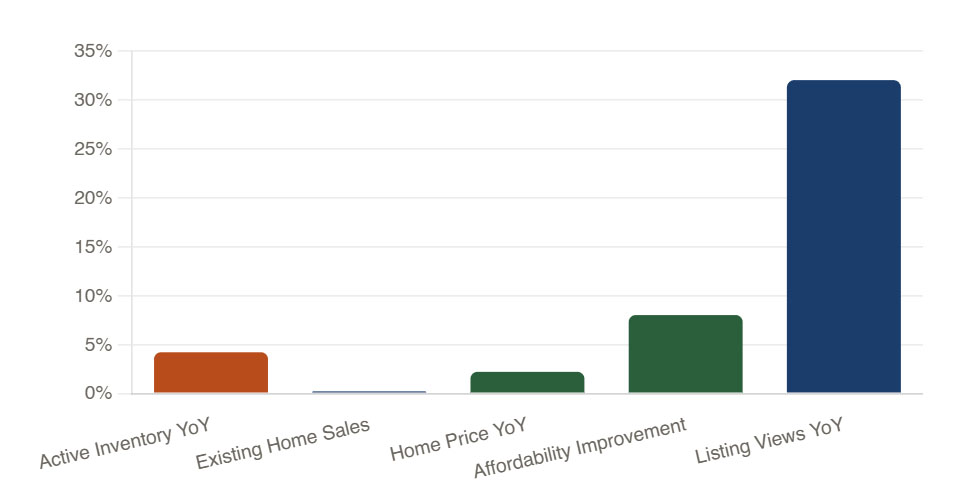
The data makes the picture very clear. According to Churchill Mortgage's May 2026 housing update, existing home sales managed just a 0.2% uptick in April, while median prices hit a record $417,700 — a market that is technically moving, but moving slowly. Inventory is up 4.2% year over year nationally, which sounds encouraging until you realize that rising supply without a matching surge in demand means listings are sitting longer. Buyers have options now. They're in no rush. And sellers who priced like it was 2022 are quietly trimming their numbers.
Meanwhile, Realtor.com's 2026 Housing Forecast describes this moment as one of cautious stabilization — incomes are growing slightly faster than home prices, and the average 30-year fixed rate is projected to hold near 6.3% for the year. That's actually a window of real opportunity if you know where to look. The problem isn't that clients aren't out there. It's that passive lead generation — the kind that worked when buyers were desperate, and sellers had all the leverage — that no longer moves the needle.
The 2026 Market Rebalancing at a Glance
Key metrics across active inventory, mortgage rate trends, and lead channel conversion rates — sources: Churchill Mortgage, Realtor.com, NAR, Inman
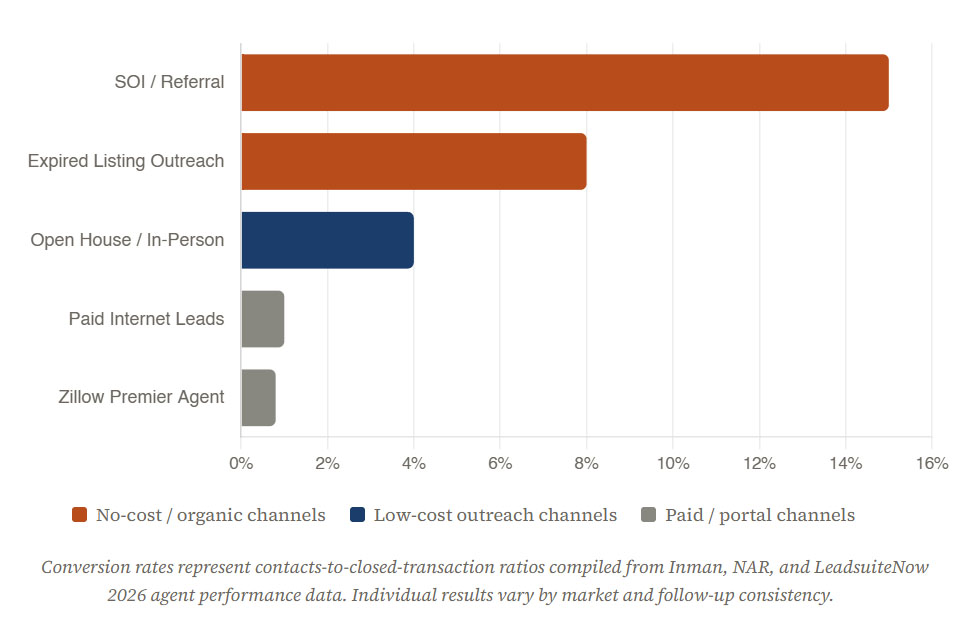
Lead Channel Conversion Rate Comparison
Referral and SOI leads convert at a dramatically higher rate than paid internet leads — 2026 data
So if the expensive ad-spend calculators aren't going to cut it this week, what actually works? When the market shifts into equilibrium, the agents who survive — and quietly thrive — are the ones who stop waiting for leads to drop into their lap and start actively solving real problems for real people in their community. Here are three strategies that are genuinely working right now.
The Commission Landscape Shift You Can't Ignore
Before we get into the three strategies, it's worth addressing the elephant in every showing. The NAR settlement changes that took full effect in 2025 have permanently restructured how buyer-agent compensation works — and how you talk about your value matters more now than it ever has before. According to 360Training's detailed breakdown of the NAR settlement rules, buyers must now sign written agreements with their agents before touring homes, commission rates are fully negotiable, and sellers can no longer simply post a blanket buyer-agent offer through the MLS.
Here's what that means practically: compensation is now negotiated deal by deal. A Fox & Sellers 2025 post-settlement analysis noted that buyer agent commissions averaged 2.55% — essentially the same as before the settlement shook the industry. The agents who panicked and slashed their rates lost business. The agents who got better at articulating their value held firm and won. This context matters because the lead generation strategies below all hinge on demonstrating that value upfront, before any MLS agreement, before any home tour, before any offer is written.
82% of all real estate transactions in 2026 are the direct result of a referral or repeat business — not a paid portal lead.
Source: HousingWire, Sphere of Influence in Real Estate, 2026
Strategy No. 1
Stop Prospecting Strangers — Audit Your Sphere First
Most agents who tell me they have a lead problem actually have a relationship problem. They're out here cold-calling expired listings and paying for internet leads from people who filled out a form at midnight just to see what their neighbor's house was worth — while ignoring 200 people in their phone who already trust them completely.
HousingWire's 2026 sphere of influence guide lays it out clearly: 88% of home buyers say they would recommend their agent to others, and the majority of buyers and sellers work with the first agent they think of. The entire game is about being that first thought. And you cannot be first in someone's mind if you haven't had a real conversation with them since you closed their deal three years ago.
Here's the thing about sphere-of-influence work that makes agents uncomfortable — it requires you to actually call people. Don't email them a market update newsletter; they'll delete without opening. Do not send them a branded magnetic calendar for their refrigerator. Actually, pick up the phone or sit across from them with a cup of coffee and ask how things are going. Inman's January 2026 strategy breakdown highlighted Heidi Harris, a team leader out of Raleigh, who stopped paying for any outside attention and focused solely on deepening relationships with people already in her world — two to three lunches or coffee meetings per week. That approach activated reciprocity and built genuine referral pipelines that no portal can replicate.
“The agents winning in 2026 understand that a relationship isn't a contact in a CRM — it's a person who would feel genuinely comfortable texting you at 9pm to ask if they should sell.”
📋 Your 48-Hour SOI Audit Action Plan
- Open your phone contacts and your CRM. Flag every person you've closed a deal with in the last five years who you haven't spoken to personally in the last 90 days.
- Call — don't text, don't email — five of those people this week. Don't lead with real estate. Ask about their job, their kids, and their renovation project. Let them bring up housing.
- For the ones you can't call yet, send a genuinely personal text. Reference something specific about them — not a mass broadcast. "Hey, I drove by your neighborhood last week and noticed a few new listings — thought of you. How are things going over there?"
- Keep a running note of anyone who mentions a life change: job move, new baby, divorce, retirement, kids leaving for college. Those are your motivated movers — follow up in 30 days.
- Block two hours every Friday morning — non-negotiable — for relationship calls. Do this for eight weeks straight and track what happens to your pipeline.
LeadsuiteNow's 2026 agent performance data shows that agents with 200 or more contacts in a well-maintained CRM who communicate monthly generate 15 to 20 referral and repeat transactions annually — that's the majority of top producer volume, and it costs exactly nothing beyond time and intentionality. Referral and repeat clients also convert at four to six times the rate of internet leads. Do the math on what you're currently spending on paid leads, and then imagine what that same time invested in real conversations would produce.
Strategy No. 2
Work the Expired Listings No One Else Is Calling
Expired listings have always been a classic prospecting target, but in a rebalancing market like this one, they hit differently. These aren't sellers who never wanted to sell — they're sellers who absolutely want to sell, who went through the entire emotional process of listing their home, held open houses, let strangers walk through their bedrooms, and then watched it sit. They're frustrated. They're confused. And in many cases, they're blaming their last agent — which means they're actively looking for someone new.
The data on why listings expire in 2026 is pretty consistent: overpricing. With inventory up 4.2% nationally and buyers no longer willing to waive inspections and appraisals, the sellers who priced based on 2022 comps rather than today's market are the ones watching their listings age out. Churchill Mortgage's April 2026 market report noted that 83% of sellers expect to get full price or more, yet 39% are already anticipating concessions — that gap between expectation and reality is exactly where your expired listing conversation begins.
⚡ Reality Check
The objection you'll hear every single time: "We already listed with an agent and it didn't sell. Why would we try again?" Your answer can't be vague optimism. It needs to be a specific, honest pricing analysis plus a concrete marketing plan that is visibly different from what they did last time. Walk in with a CMA and a story — not just a listing presentation.
“The agents winning in 2026 understand that a relationship isn't a contact in a CRM — it's a person who would feel genuinely comfortable texting you at 9pm to ask if they should sell.”
📋 The Expired Listing Approach That Doesn't Get Hung Up On
- Pull your MLS every morning for listings that expired in the last 7 days — anything sitting longer is already getting called by everyone.
- Skip the generic "I have buyers" letter. Write a genuine, personalized note that demonstrates you've actually looked at their property and their pricing history. "I noticed your home at [address] came off the market after 62 days — I've been tracking the two comparable sales in your neighborhood, and I think I can show you exactly what happened."
- Call within 24 hours of expiration. The agents who win these are the ones who show up first with a real answer, not the fifth person to mail a postcard.
- Bring a printed, two-page market analysis to the first meeting. Not an iPad. The paper shows preparation. It also means they have something to look at while you talk.
- Come in with a price, not a range. A seller who just watched their house sit unsold doesn't need you to hedge — they need you to tell them the honest number and explain exactly why it will work this time.
One thing agents consistently underestimate about expired listing outreach: the conversation often doesn't close on the first call. That's fine. Your goal is to be the person they remember when they're ready to relist — which is usually four to six weeks after expiration. A quick, thoughtful follow-up call in that window — "Just checking in, I know the timing might not have been right before — has anything changed for you?" — closes far more expired listing opportunities than any initial pitch.
39% of sellers in 2026 are already anticipating having to offer concessions — despite 83% initially expecting full price. This pricing gap is your entry point.
Source: Churchill Mortgage April 2026 Real Estate Market Update
Strategy No. 3
Use Social Media as a Lead Capture Tool, Not a Billboard
Most agents are doing social media completely wrong — and I say that having watched a lot of Instagram feeds that are just a wall of "Just Listed" and "Just Sold" posts that get five likes (three of which are from other agents). Those posts serve your ego. They don't generate leads. The people in your market who are thinking about buying or selling are not going to DM you because you posted a Canva graphic about a house that sold in Birchwood Estates.
The agents who are actually converting social media into real conversations in 2026 are doing something specific: they're engineering a reason for someone to raise their hand. Inman's 2026 lead generation guide points to a strategy popularized by Sharran Srivatsaa and now widely taught by most serious real estate coaches — the off-market opportunity post. Something like: "Some of the best deals I see never actually hit the open market. If you want to be on my early-bird list and hear about homes before they're publicly listed, comment below or DM me." That post creates a specific action someone can take. And the people who take it are self-identifying as active buyers.
A post that teaches something or opens a door gets shares.
A post that just celebrates your closing gets nothing. One is a conversation starter; the other is a press release nobody asked for.
Beyond the off-market post, there's a category of content that works exceptionally well in a market like this: hyper-local, unglamorous real estate education. Not "5 Tips for First-Time Homebuyers" — everyone posts that. I'm talking about the stuff buyers and sellers are actually confused about right now: what a buyer representation agreement actually means and what you're agreeing to when you sign one, how seller concessions work in the current market, and why a house that's been on the market for 45 days isn't necessarily a bad deal. This is where the NAR commission changes become a content opportunity. People are genuinely confused about how agents get paid now. Be the person who explains it clearly, without jargon, without spin. That builds trust faster than any "Congratulations to my clients!" post ever will.
Yelo Marketing's 2026 lead generation study found that 22.7% of agent referrals now come through social media and networking, with networking generating a more than 40% return on investment among surveyed agents. Free lead generation through platforms like Instagram, Facebook, and even LinkedIn isn't a backup plan — it's a primary channel for agents who work it consistently and strategically.
• Post three times per week — no more until you've nailed three. Quality and consistency beat volume every single time.
• One post per week should be a market update specific to your city or neighborhood. Hyper-local knowledge beats generic national stats every time.
• One post per week should answer a real client question you've heard recently. Be honest, direct, and helpful — not salesy.
• One post per week should give people a reason to identify themselves as potential clients — off-market lists, home valuation CTAs, or simple polls.
• Respond to every DM, comment, and reply quickly if possible. Responsiveness is a form of prospecting — and people notice it.
One more thing about social that most people skip: the follow-up DM after a new follower or engagement. If someone comments on your post or shares your market update, a simple "Hey, I noticed you engaged with that post — are you thinking about making a move in the area? Happy to answer any questions" works at a surprising rate. Not every time, obviously. But at zero cost, the conversion math is spectacular compared to any paid channel.
The Honest Part: This Takes Time to Build, But You Start This Week
None of these strategies produces an under-contract client by Friday. I want to be straight about that. What they produce — when worked consistently over six to eight weeks — is a pipeline that doesn't require you to keep feeding a paid lead machine just to stay in the game. The market we're in right now rewards agents who are present in real ways: on the phone, in the community, at coffee shops, in people's social feeds with actually useful information.
The commission landscape has also changed in ways that favor agents who are willing to articulate their value instead of just expecting it to be assumed. Century 21 Jordan-Link's breakdown of the 2026 NAR rule changes puts it simply: brokers who embrace transparency and adapt their business models will be well-positioned. Agents who are still approaching compensation conversations the way they did in 2022 are going to continue feeling the squeeze. The solution isn't a lower commission — it's a clearer story about what you actually do for that commission.
The real estate market in 2026 is not broken. It is rebalancing. And rebalancing markets are, historically, exactly where skilled agents build the foundations of durable businesses — because the agents who couldn't pivot have already left, and the ones who remain are operating with less noise. Your competition just thinned itself. Act accordingly.
Start With One Thing This Week
Pick one strategy from this list. Just one. Call five people in your sphere by Thursday. Pull this week's expired listings in your market and write two personalized notes. Or draft one piece of genuinely useful local market content for social. Don't try to implement all three simultaneously — you'll do none of them well. Do one, measure it, then add the next. That's how a pipeline gets built.
 </p
</p