Beyond the MLS: 3 Strategies to Find Hidden Listings
Jun 19, 2026
Written by Discount Property Investor Team
When the listings dry up, the best agents don't wait. They build their own pipeline — here's exactly how.
Let's be honest. If your entire prospecting strategy in 2026 still revolves around refreshing the MLS every morning and hoping a new listing drops, you're already losing. Not because the MLS isn't useful — it is — but because it's the same 58,000 agents in your region refreshing the same feed. You're competing on a playing field that was never designed to give you an edge.
The U.S. housing market is structurally short on supply. Freddie Mac estimates the country needs roughly 3.7 million more homes than exist today to meet long-term demand.² Even with active listings rising about 10% year-over-year in early 2026,⁴ inventory remains 12% below pre-COVID baselines.¹ Realtor.com's Chief Economist Danielle Hale noted that at current construction rates, it would take roughly 7.5 years just to close the existing supply gap.⁴ That's not a blip — that's the environment you're operating in, probably for the rest of this decade.
The agents who are thriving right now — consistently closing listings and keeping buyers off the sideline — aren't relying on luck or volume. They're using three specific strategies that most agents either don't know about or haven't fully built into their daily operation. I'm going to walk you through each one in detail.
U.S. housing inventory vs. balance benchmarks (2019–2026 est.)
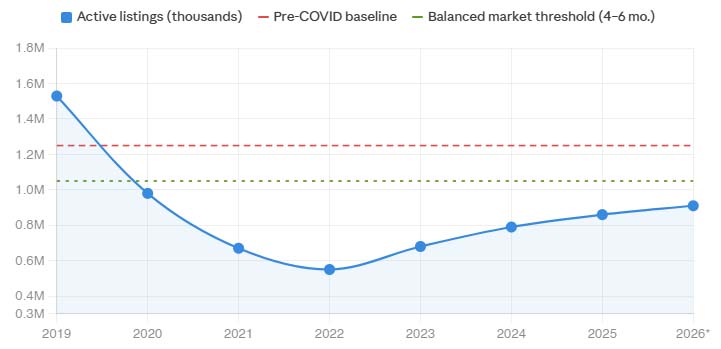
Sources: Realtor.com, NAR. Jan 2026 figure of 912,696 active listings per Realtor.com data.
1. Mastering owner financing and off-market deals
The phrase "off-market deal" gets thrown around a lot, but most agents approach it wrong. They think off-market means whispering to a few investor contacts or mass-mailing a neighborhood. That's not a strategy — that's hope with postage on it.
Real off-market deal flow starts with one specific type of homeowner: the tired landlord. This is a person who owns one to four rental units, has held them for more than a decade, is somewhere between 58 and 72 years old, and has quietly been dealing with tenant headaches, deferred maintenance, and a property manager who costs them more every year. They haven't called an agent because they don't think selling makes sense — they're worried about capital gains taxes, they're not sure where they'd put the money, and honestly, they don't want the hassle of showings.
Here's where owner financing changes the conversation entirely. When you approach this seller not with "I have a buyer at market price" but with "what if I could structure this so you become the bank, earn interest income every month, and defer a significant chunk of your capital gains exposure" — you get a completely different reaction. You're not pitching a sale. You're pitching a wealth management solution that happens to involve selling the property.
The mechanics are straightforward. In a seller-financed deal, the homeowner carries the note — they effectively act as the mortgage lender, and the buyer makes monthly payments directly to them (or through a servicing company). The seller avoids a lump-sum capital gain, spreads income over time, and in many cases ends up with a better effective return than they'd get from putting proceeds into a CD or bond ladder. For the buyer, it eliminates the conventional lender, which matters enormously in a market where middle-income buyers can afford just 21% of available homes at current rates — down from around 50% before the pandemic, per NAR data.
Inventory is not just low — it's being held back by financial decisions, not lack of demand to sell. Many homeowners have mortgage rates between 2.5–4%. Selling means giving that up.
— Market analysis, Exit Realty, April 2026²
The key to making this work isn't just knowing the concept — it's having a conversation framework that positions you as a problem-solver, not a commission-chaser. When you knock on a door or pick up the phone, your opening is never "do you want to sell?" Your opening is "I've been helping a few property owners in this zip code think through their options as they look toward retirement — do you have 15 minutes?" That's it. You're not there to pitch. You're there to listen.
For Sale By Owner sellers are the other major segment here. FSBOs are often misunderstood as combative or commission-resistant, but the reality is that most FSBOs fail to sell within 90 days and end up listing with an agent anyway. The ones who are still on the market after 30 days are quietly frustrated and open to a different conversation. Come with data — what comparable homes actually closed at, carrying cost math if they're also trying to buy —, and you'll find most FSBOs are more receptive than agents expect. Owner financing can work here, too, particularly if the FSBO seller is free and clear on the property.
Playbook: approaching a tired landlord
Pull county records for rental properties with ownership tenure of 10+ years and owner age 55+
Lead with a market update letter — not a solicitation. Mail it twice before calling
In the call, ask open questions about their property management experience. Let them vent
Introduce seller financing as a concept only after establishing that they have a capital gains concern or cash-flow goal
Always bring a CPA referral into the conversation — you're not their tax advisor, but knowing one builds trust
2. Predictive analytics: find sellers before they know they're selling
This is the strategy that separates agents doing $3M in volume from those doing $15M, and it has nothing to do with hustle or charisma. It has everything to do with data.
Predictive analytics in real estate works by pulling together dozens of signals from public property records — length of ownership, equity position, estimated life events like job changes or children aging out of schools, mortgage type, liens, and even neighborhood transaction velocity — and running them through models that assign each homeowner a likelihood-to-sell score. The higher the score, the more the data suggests that the person is moving toward a transaction in the next six to twelve months.
The numbers back this up. Predictive models from platforms like SmartZip and Offrs can identify likely sellers with 60–80% accuracy in many markets.³ Compare that to traditional door-knocking conversion rates — which sit well below 1% — and the math on your prospecting time gets completely different. You're not casting a wide net anymore. You're using a fish finder.
The practical implementation looks like this: you pick a zip code or farm area, run a predictive list, and come out with a ranked group of homeowners — typically the top 5–10% most likely to list in the next year. That might be 40 to 80 households in a typical suburban neighborhood. You build a 6-touch outreach sequence for each one: a market value update mailer, a follow-up postcard two weeks later, a door knock at month two, and a handwritten note at month four. You're staying in front of the people statistically most likely to pick up the phone and call you — often months before they've consciously decided to sell.
Prospecting method comparison: contact-to-appointment conversion rate (est.)
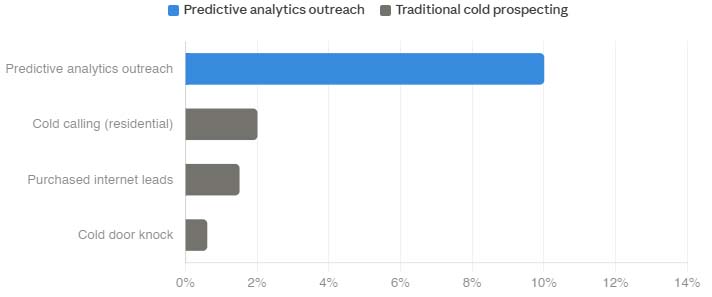
Sources: Jamil Academy/industry data, 2026. Zillow leads cited at $100+ each in competitive zip codes with 1-2% conversion.
One important reality check: predictive analytics is a long game. The average predicted seller takes three to nine months from first contact to signing a listing agreement.³ If you need listings next month, this alone won't solve it. The move is to run predictive outreach in parallel with more immediate tactics — FSBO follow-up, expired listings, the circle prospecting I'll cover next — so you're always feeding both the short and long ends of your pipeline.
The data signals that tend to predict a sale most reliably: ownership tenure of 7–10 years (people move roughly every 7–10 years on average), high accumulated equity relative to current rates, children reaching high school senior year (schools are often the main reason people stay put), and any lien, permit, or code violation activity suggesting the owner is already actively dealing with the property. When you see several of these stacked together, you're looking at a warm lead — even if that homeowner has never told another soul they're thinking about selling.
Tools worth evaluating in 2026
SmartZip — territory-based seller scoring works well for established farm areas
Offrs — predictive scoring with zip-code exclusivity, strong for suburban residential
PropStream — more DIY, excellent for pulling public record data and building your own lists
ATTOM — used more by investors and lenders, but accessible for agents doing serious data work
Your county assessor's website — free, underutilized, and more current than most agents realize
3. The circle prospecting playbook: turn one sale into three listings
This is the highest-ROI prospecting tactic most agents underuse. When a home sells in a neighborhood — whether it was your listing or not — there are typically 40 to 60 homeowners within a quarter-mile radius who just got handed the most compelling piece of data you could ever give them: what their neighbor's house sold for.
That data triggers something. Suddenly, people who were vaguely curious about their home's value are actively calculating. "If they got $590,000 for that smaller house, what would mine sell for?" That's a moment of real intent — and if you show up with the right message within 48 to 72 hours of that close, you're catching people at peak interest.
Circle prospecting done properly is not a mass-mail blast. It's a tight, targeted, three-channel approach: a phone call first (if you can get numbers from a skip-trace tool), a door knock within the first week, and a handwritten card within two weeks. The message is simple — you just helped close a home nearby, you know demand is high right now, and you're wondering if they've ever thought about their timing. You're not pushing. You're informing and asking.
The "three listings from one" framework works because of a statistical reality: in most suburban neighborhoods, roughly 6–8% of homes turn over every year. In a neighborhood of 500 homes, that's 30–40 transactions annually. If you handle even 20% of those through disciplined circle prospecting, you're looking at six to eight deals per year from one neighborhood alone. That's a business, not a hustle.
Rising inventory doesn't mean panic. It means strategy matters more. When supply grows, pricing and marketing precision become critical.
— The McClung Group, February 2026⁶
The content of your outreach matters as much as the timing. Generic "just sold" postcards get recycled with the pizza coupons. What works is specificity — tell them the address, the sale price, how many days it was on market, and how many offers it received. Then tell them what that implies for their property. You're not a mailer. You're a local market analyst who happens to have a real estate license.
Your follow-up sequence for the circle should run for 90 days, not 10. Most agents make one pass and call it done. The ones who consistently convert are the ones who show up three times in the first month — phone, door, card — and then drop to a monthly value-add touchpoint (a neighborhood market update, a relevant article, a note about a new listing coming to the area). By the time someone in that circle is ready to list, you're not a stranger they got a postcard from. You're the agent they've heard from five times who clearly knows their neighborhood cold.
One underrated move inside the circle: ask the new buyers if they know anyone in the neighborhood. People who just moved to a street are eager to connect — they'll often tell you the neighbor who mentioned they were thinking about retiring and downsizing, or the couple who just had their third kid and have outgrown their house. These referrals are warm by definition, because they come through a homeowner who just went through the process with you.
Estimated pipeline potential: circle prospecting in a 500-home neighborhood
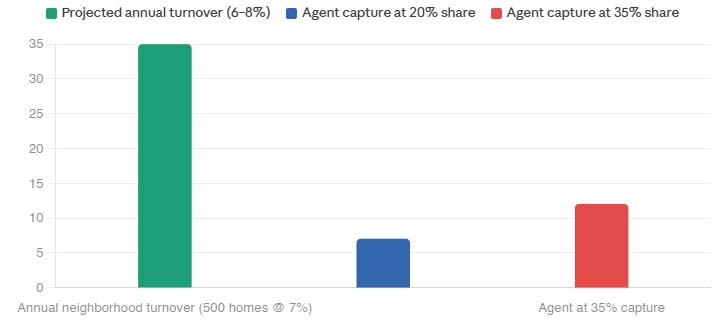
Illustrative model based on NAR average annual turnover rates and circle prospecting capture benchmarks.
Putting it together: the pipeline stack
These three strategies are not mutually exclusive — they're designed to stack. Predictive analytics gives you your 6–12 month pipeline: a ranked list of homeowners who are statistically moving toward a decision, who you're nurturing with consistent, value-driven contact. Circle prospecting gives you your 0–90-day pipeline: people whose attention was just triggered by a neighborhood sale, who are primed to have a conversation right now. Owner financing and off-market outreach give you the deals no one else is even competing for — the tired landlords, the FSBOs who've been stuck, the long-term owners who didn't know there was a smarter way to exit.
Together, they mean your listing pipeline never goes cold. There's always something moving, always a conversation to have, always a homeowner somewhere in a journey that ends with you earning a commission — not because you happened to be on Zillow at the right time, but because you built the infrastructure to find inventory before it becomes inventory.
That's the actual edge in 2026. Not hustle. Not volume. Infrastructure and information run consistently in a market that rewards the agents who know where to look.
If this kind of system-building is where you want to focus — the pipeline architecture, the data tools, the conversation frameworks — that's exactly what we work on in one-on-one strategy sessions. Reach out directly if that's a conversation worth having.