Real Estate Pipeline Predictability: A 2026 Playbook
Jul 25, 2026
Written by Discount Property Investor Team
The "feast or famine" cycle is still the number one career-killer in U.S. real estate. Here's how rookies and veterans are replacing luck with a system — and what the 2026 data says actually moves the needle
You know the month. The one where your calendar is wall-to-wall with closings, your phone won't stop buzzing with referrals, and you're turning down showings because there simply aren't enough hours. And then you know the month that follows it — the quiet one, where the CRM goes stale, the open houses draw three people who already have an agent, and you start doing the math on how long your savings actually last.
That swing isn't bad luck. It's a business model problem. Most agents — new and experienced — are running on manual prospecting, a system that scales only with their own time, energy, and mood on any given Tuesday. The agents who eventually flatten out that curve aren't working harder. They've swapped manual prospecting for something that keeps producing leads whether or not they personally made calls that day.
This isn't a small distinction, and it isn't evenly distributed across the industry. Production data on U.S. agents is blunt about the gap: a small slice of agents account for the overwhelming majority of transactions closed in a given year, while most of the field closes a handful of deals and calls it a living. The difference isn't talent. It's infrastructure.
And infrastructure looks different depending on where you are in your career, which is exactly where most advice on this topic goes wrong. A blanket "just post more content" or "just cold call an hour a day" plan ignores the fact that a first-year agent and a fifteen-year veteran are solving two completely different problems. A rookie's problem is trust — nobody in the market knows them yet, so every lead has to be earned one relationship at a time. A veteran's problem is volume and filtering — they already have more inbound interest than they can personally qualify, and the risk is spending high-value hours on low-value conversations. Building the same system for both stages wastes effort in both directions.
What follows are two separate playbooks, built around where the actual leverage point sits at each stage: a database-first foundation for agents still building their name, and an automation-and-filtering system for agents whose name is already doing some of the work. Both are grounded in 2026 production data rather than gut feel, because "it worked for me" advice is exactly the kind of thing that keeps agents stuck in the feast-or-famine cycle in the first place.
01 / THE PROBLEM
The Real Cost of Feast-or-Famine
Before getting into fixes, it's worth sitting with why this cycle is so expensive. It's not just the stress — though that's real. It's that manual, reactive prospecting means you're constantly starting your funnel over from empty. Every slow month means a slow month three months later too, because there was no pipeline being filled in the background.
The 2026 data on where deals actually come from makes the case for systemization better than any pep talk could. Not all lead sources are created equal, and the gap between the best and worst is enormous:
Lead-to-Close Conversion by Source
Share of leads from each channel that close, U.S. residential agents, 2026
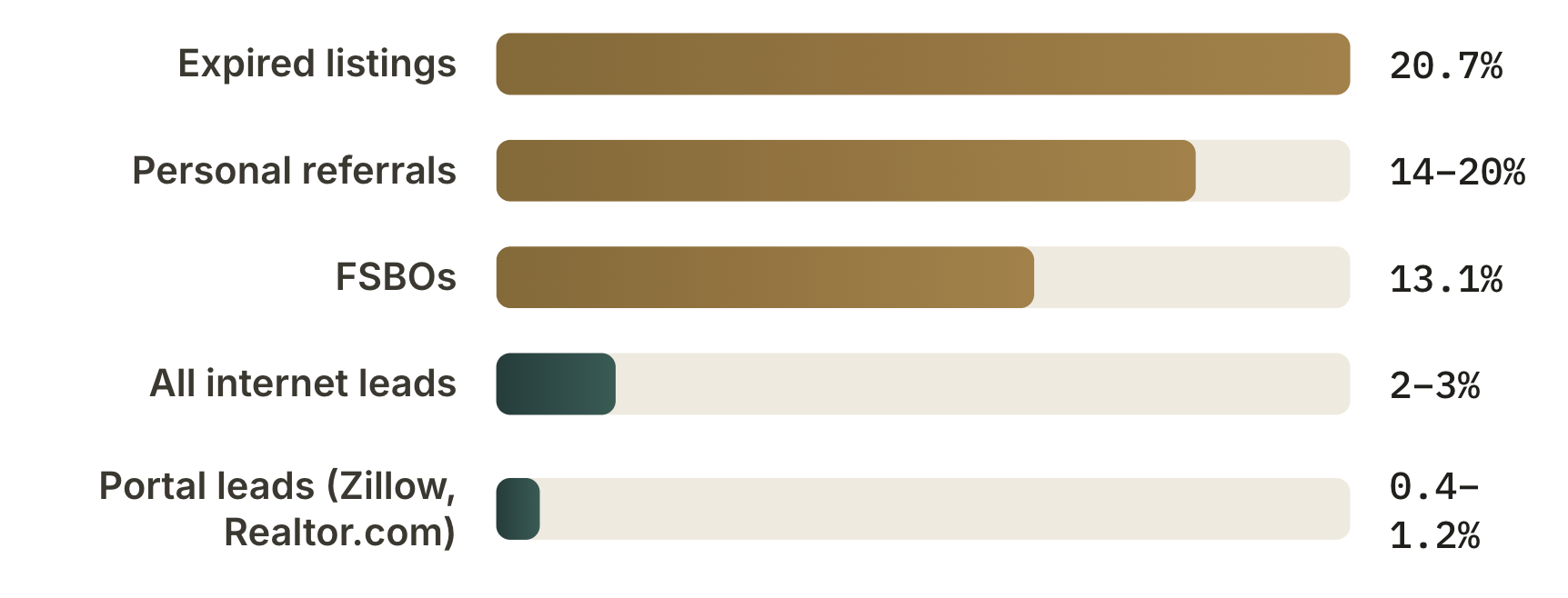
Figures compiled from REDX's 2026 Lead ROI Rankings and NAR data, as reported by CloseDaily's 2026 lead generation statistics roundup and Deal Machine OS's 2026 conversion benchmark report.
Read that chart the way a lender reads a rent roll: it's telling you where your time is actually worth something. Cold portal leads and generic internet inquiries close at under three percent, while a warm referral or a properly worked expired listing closes at somewhere between six and ten times that rate. According to that same Deal Machine OS benchmark, agents who use a CRM consistently see a 29 to 41 percent lift in conversion over agents who don't, and the average buyer spends roughly ten weeks searching before they purchase — which means a lead you gave up on after three follow-ups may well have closed with a fourth or fifth.
None of this means cold prospecting is dead. It means the fix for feast-or-famine isn't "do more of everything." It's building two different systems depending on where you are in your career — one that establishes trust when you don't have much of a track record yet, and one that filters volume once trust and time become your scarce resources instead.
It's also worth being honest about channel mix, because most agents over-invest in the channels that feel productive and under-invest in the ones that actually convert. The same 2026 CloseDaily data shows that 96 percent of homebuyers now use online tools somewhere in their search, and 88 percent still end up buying through a licensed agent or broker despite all the noise about disruption. Those two facts together tell you the job hasn't changed as much as the marketing industry wants agents to believe — buyers still want a human they trust to guide the transaction. What's changed is how they find that human in the first place, and that's a search-and-trust problem, not a spend-more-on-ads problem. A local search presence, a maintained database, and a fast, personal follow-up still beat a bigger ad budget on their own.
Track 01 · First 1–3 Years
The Rookie Playbook: The "Database First" Foundation
When you're new, you don't have a marketing budget that can compete with a brokerage's national ad spend, and you shouldn't try to. Your actual asset is smaller and more valuable than money: it's your sphere of influence, and your ability to have a high-trust conversation without sounding like you're selling something. Agents who keep 200-plus contacts in a maintained CRM and touch them monthly with market updates, personal notes, and holiday check-ins tend to generate 15 to 20 referral or repeat transactions a year on their own — no ad spend required. That lines up with what The Close's 2026 statistics report found on referrals broadly: they remain one of the highest-trust, highest-converting sources in the business, and a maintained database is what keeps that referral engine running instead of relying on it to happen by chance.
Segment your CRM immediately
Don't treat every contact the same. Split your database into three tiers the day you build it, not six months from now when it's already a mess:
- A-list: past clients and close friends who actively refer you without being asked.
- B-list: casual acquaintances, local business owners, people you'd recognize at the grocery store.
- C-list: cold leads, open house sign-ins, anyone you haven't built real trust with yet.
The point of segmenting isn't organization for its own sake — it's that each tier earns a different kind of outreach. Your A-list gets a phone call. Your B-list gets a personal note or a quick voice memo, something that feels like it came from a person rather than a platform. Your C-list gets a value-first email — something useful with no ask attached, at least at first. Blast the same generic newsletter to all three and you'll flatten the very relationships that are supposed to be your competitive edge.
This also solves a problem most new agents don't see coming: database rot. A contact list with 300 names and no tiering looks impressive on paper, but if you can't tell at a glance who actually picks up when you call, you don't have a database — you have a spreadsheet. Segmenting forces you to actually know your people, which is the entire point of having a sphere of influence in the first place.
● Deliver hyperlocal value, not generic content
Stop sending recipe cards and automated "daylight saving time just ended" reminders. Nobody forwards those to a friend who's thinking about selling. Instead, send an annual equity check-up: a short video or a one-page breakdown showing exactly what a specific neighborhood — not the metro area, the actual streets — gained in value over the last twelve months.
This works because it's specific in a way generic content never is. A homeowner doesn't care what happened to "the market." They care what happened to their block. When you can answer that question before they've thought to ask it, you become the agent they call when they're finally ready to sell — and often the one they refer to a neighbor first.
The format matters less than the specificity. A ninety-second phone video walking through three recent comps on their actual street beats a polished PDF every time, because it's obviously made for them and not for a mailing list of five thousand. If you're short on time, even a one-page snapshot with three data points — median price change, days on market, and one recent comparable sale nearby — does the job. The goal isn't to impress anyone with production value. It's to be the person who noticed.
● The "5-3-1" daily rule
Momentum in this business is built in daily minutes, not weekend sprints. A simple cadence keeps you from letting a slow week turn into a slow quarter:
- 5 check-in touches with people already in your database — no ask, just a real conversation.
- 3 proactive prospecting contacts: an expired listing, a FSBO, or a local vendor introduction.
- 1 face-to-face meeting or video consultation, booked and held every single day.
It sounds almost too small to matter. It isn't. Twenty working days a month at that pace is 100 database touches, 60 prospecting contacts, and 20 real conversations — a pipeline most agents never build because they're waiting for a slow month to "catch up," which never actually arrives.
The rule also works because it's small enough to survive a bad day. A goal like "make 50 calls today" gets skipped entirely the moment something goes wrong — a closing falls through, a client emergency eats your afternoon, and the whole plan collapses. Five check-ins, three prospecting contacts, and one meeting can happen even on a rough day, which is exactly why it protects the pipeline better than a more ambitious plan that only works when everything goes right.
Track 02 · Established Agents & Investors
The Seasoned Pro Playbook: Automation & High-Intent Funnels
If you've been in the business for years, your bottleneck has quietly shifted. It's no longer lead generation — leads aren't the scarce resource anymore. It's conversion capacity and bandwidth. You can't personally dial every internet inquiry and expect it to be a good use of a $12,000-commission afternoon. According to The Close's 2026 lead generation statistics report, referrals remain one of the most trusted and highest-converting sources in the business even as digital advertising has grown — which means the veteran's job isn't to abandon relationship-based lead flow, it's to build infrastructure around it that filters out tire-kickers before they ever reach your calendar.
● Deploy interactive lead magnets, not static PDFs
A downloadable "10 Tips for Selling Your Home" PDF was a fine idea in 2015. It doesn't convert the way it used to, because it asks for an email address and gives nothing personalized in return. High-producing teams have replaced them with interactive tools: a cash-to-close calculator, an instant rental ROI evaluator, an off-market property matching quiz.
The difference isn't cosmetic. A calculator captures real inputs — price range, down payment, timeline, whether they're relocating — and hands you a pre-qualified lead with context attached, before you've spent a minute on the phone. You're not starting the conversation with "so, tell me about yourself." You're starting it with "I saw you're looking in the $450–500K range with a 10% down payment — here's what that actually looks like right now."
Investors get the same benefit from a different tool. A rental ROI evaluator that asks for a property address, estimated rehab budget, and target cap rate does the qualifying work a phone screen used to require — by the time someone books a call, you already know whether the deal fits their criteria or whether you're about to spend twenty minutes explaining why it doesn't. That's twenty minutes back on both ends, and a much higher percentage of calls that actually go somewhere.
● Build omni-channel retargeting
A prospect visits your site once, gets distracted, and leaves. Most agents let that lead evaporate. It doesn't have to. Pixel-based retargeting through Meta and Google display networks lets your brand keep showing up — short, genuinely useful video content, not a banner ad — to anyone who visited your site or engaged with your social pages in the last 90 days.
This matters more than it sounds like it should, because the same Deal Machine OS 2026 benchmark data shows that combining SEO with paid advertising produces roughly a 3.1× return, the strongest blended ROI of any channel measured, and that video content alone drives over four times the inquiries of a plain listing post. Retargeting is how you make sure that math compounds instead of resetting to zero every time someone closes a tab.
The content that performs in retargeting isn't the content agents default to. It's not another listing photo carousel — it's a short answer to a real question, delivered on camera: what a buyer's agency agreement actually means for them, what an appraisal gap is and who typically covers it, what changed in their specific submarket in the last thirty days. Educational beats promotional almost every time in this format, because the person seeing the ad already knows who you are. What they need next is a reason to trust your judgment, not another reminder that you exist.
● Leverage a virtual assistant or ISA for initial scrubbing
Never let a seasoned agent spend three hours a day dialing cold internet leads. That's the most expensive labor in your business doing the least valuable task in it. An inside sales assistant — in-house or virtual — can scrub incoming leads, run the first round of text and call outreach, and drop only warm, vetted appointments straight onto your calendar.
This is also where the math gets more forgiving than most agents assume. A detailed 2026 pricing breakdown from NurtureOS puts virtual ISA services anywhere from about $720 a month for part-time coverage up to roughly $1,988 a month for a full-time hire — well under the median agent's annual marketing and operations budget of roughly $8,010, and a fraction of the $55,000-plus a year an in-house hire typically costs once you factor in ramp time and turnover. If a scrubbed, pre-qualified pipeline helps you close even one extra deal a quarter that would otherwise have gone cold, the assistant has already paid for the year.
The transition point isn't about tenure, it's about volume. Somewhere around twenty or more fresh leads a month, manually scrubbing every one of them stops being a reasonable use of an agent's time regardless of how long they've been licensed. Below that threshold, a generalist assistant handling admin and some follow-up is usually enough. Above it, a dedicated ISA — someone whose entire job is response speed and qualification — becomes less of a luxury hire and more of a basic cost of running the business at that scale.
💡 Pro Takeaway
True scale happens when your marketing has already generated enough trust that by the time a prospect gets you on the phone, they're not asking "Why should I work with you?" They're asking "What are our next steps?" Everything above—the segmentation, the calculators, the retargeting, the scrubbing—exists to get you to that second question faster.
Common Questions From Agents Building This Out
● How long before a database-first strategy actually produces deals?
Most agents who commit to consistent segmentation and the 5-3-1 cadence start seeing measurable referral activity in the second or third month, with the real compounding effect showing up closer to the nine-to-twelve month mark. That lag is exactly why so many agents abandon the approach — it doesn't feel productive in week two the way a paid lead campaign does, even though it tends to outperform paid leads on cost-per-closed-deal within the first year.
● Do I need a CRM before any of this works?
Yes, even a simple one. Segmentation and the 5-3-1 rule both depend on being able to see, at a glance, who's overdue for a touch and which tier they're in. A spreadsheet can technically do this for the first hundred contacts. It stops working well past that point, which is usually right around when the discipline starts paying off — so it's worth moving to a proper CRM before that friction talks you out of the habit.
● Is it worth building interactive tools if I'm not techy?
You don't need to build these from scratch. Most CRM and website platforms built for agents now include calculator and quiz widgets as standard features — the job isn't development, it's deciding which questions actually pre-qualify a lead in your specific market and configuring the tool to ask them. An hour of setup is usually enough to get a usable version live.
How to Tell If Your Pipeline Is Actually Getting More Predictable
Systemizing lead generation only matters if you can measure whether it's working, and most agents track the wrong number. Total leads generated feels good to report but tells you almost nothing about predictability. A few metrics do a better job of showing whether the feast-or-famine swing is actually flattening out:
- Lead source concentration. If more than half your pipeline comes from a single channel, you don't have a system — you have a dependency. A healthy mix draws from database referrals, expireds or FSBOs, and at least one digital channel, so a slowdown in one doesn't sink the whole month.
- Response time on new leads. The gap between a fast and a slow response is one of the widest swings in this business — agents who respond within a few minutes rather than tens of minutes convert noticeably more of their inbound inquiries into actual appointments, a pattern that shows up consistently across the 2026 conversion data referenced throughout this piece. If this number is creeping up, that's usually the first sign bandwidth has become the bottleneck, not lead volume.
- Appointments booked per week, not leads captured per week. Leads are a vanity metric until they turn into a conversation. Tracking booked appointments forces you to look at conversion, which is the number that actually predicts next quarter's closings.
- Follow-up touches per active lead. Given a median ten-week buyer search window, a lead with only two or three touches on file hasn't been worked — it's been abandoned. Tracking this number honestly is often the single fastest way to find deals hiding in a pipeline that looks slow.
None of these require sophisticated reporting. A simple monthly review of these four numbers, even in a basic spreadsheet, will tell you more about whether your system is working than watching your closing count bounce up and down ever will — because by the time closings dip, the cause was usually set in motion two or three months earlier.
Bringing Both Tracks Together
Rookie or veteran, the underlying principle doesn't change: a pipeline that depends entirely on your personal energy that day is not a system, it's a habit — and habits break the moment life gets in the way. A system, by definition, keeps producing leads on the days you don't feel like prospecting.
The specifics scale with where you are. Early on, that system is mostly you — a segmented database, a daily cadence, and content specific enough to a single neighborhood that it feels personal because it is. Later, the system becomes infrastructure — tools that qualify before you ever pick up the phone, retargeting that keeps your name in front of someone who already showed interest, and a second set of hands scrubbing the noise out of your lead flow so your own time goes toward the calls actually worth taking.
What doesn't change is the discipline underneath both versions. The agents who post steady numbers year over year aren't the ones who get lucky with a hot referral every so often. They're the ones who built something that runs whether or not this particular week feels busy — and that's the entire difference between a career built on feast-or-famine and one built on a pipeline you can actually predict.