Why Sellers Are Delisting & How to Win Open Houses
Jun 06, 2026
Written by David Dodge
It's peak season. So why are more homes disappearing from the MLS than any June in recent memory? Here's what the data says — and what top agents are doing about it right now.
I've been watching the numbers roll in since late spring, and something is genuinely off about this market. It's not doom-and-gloom off — it's interesting off. The kind of market that, if you know how to read it, gives a serious agent a serious edge over everyone waiting around for conditions to normalize.
Here's the headline: according to Redfin's June 2026 report, 5.8% of all U.S. home listings were pulled off the market in April alone — tied with December 2025 for the highest delisting share since March 2020, when a pandemic literally stopped the world. And unlike the COVID freeze, there's no once-in-a-generation external event to blame. This is organic stagnation. Seller frustration at scale. A standoff between what homeowners think their properties are worth and what buyers — squeezed on affordability — are actually willing to pay.
If you're going into open houses this weekend armed with the same enthusiasm and the same flyers you've been using since 2022, you're going to have a rough time. This post is about changing that.
Let's Actually Look at the Data
Before we get into strategy, I want to ground us in what's really happening — because the numbers are stranger than most people realize.
U.S. Home Delistings as a % of Active Inventory (2022–2026)
The delisting share has surged to its highest level since the pandemic onset, defying typical spring-season patterns.
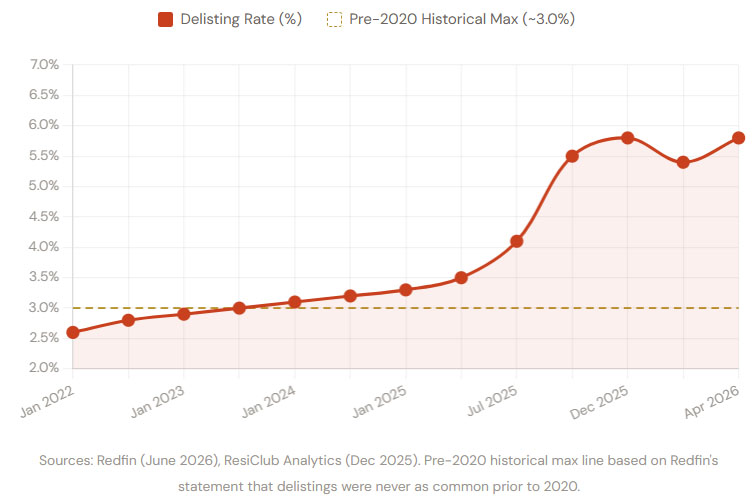
Redfin's data shows delistings rose 3.8% month-over-month in April, right in the heart of spring selling season — the time of year when buyer demand is supposed to be peaking. That timing matters. This isn't sellers pulling back in slow December. This is sellers giving up in April and May, when every piece of conventional wisdom says the market should be working in their favor.
The cause isn't complicated once you look at it honestly. We have three forces colliding at once.
First, a group of sellers still anchored to 2021 and 2022 price expectations — the pandemic era when bidding wars were the norm, and homes flew off the market in 48 hours. Those days are gone, but the memory of those prices isn't. Second, Freddie Mac's latest weekly survey (June 4, 2026) puts the 30-year fixed rate at 6.48% — down slightly from recent highs but still nearly a full percentage point above where it was a year ago, and miles from the sub-3% world some sellers bought into. Third, buyers have quietly accumulated real negotiating leverage. In many markets, listings have stacked up faster than demand can absorb them, meaning a buyer walking away from an overpriced home has other options.
The result? A June that feels nothing like June. Buyers are cautious, skeptical, and tired of being told to "just get in the market." Sellers are frustrated and pulling back. And most agents are stuck in the middle, wondering why their usual playbook isn't working.
Here's what I think: this market isn't broken. It's just asking for a different kind of agent. One who understands the psychology of frustrated sellers and cautious buyers — and has specific conversations ready for both.
The 3 Strategies That Are Actually Working Right Now
Strategy 01: The "Why Did They Delist?" Reverse-Prospecting Hack
Most agents wait. They wait for listings to expire, for sellers to get desperate, for the phone to ring. That's a losing approach in this market, because ResiClub Analytics notes that roughly one in five homes delisted over recent months were re-listed within three months. That means a wave of frustrated, motivated sellers is going to come back to the market — and whoever reaches them first builds the relationship.
These aren't cold leads. These are homeowners who wanted to sell badly enough to list, went through the process, didn't get what they wanted, and are now sitting at home still trying to figure out their next move. That's a person ready to have a real conversation.
The workflow is simple. Filter your MLS for "Temporarily Off Market" or "Withdrawn" status from the last 14 days. Then reach out — not to pitch, but to listen. The framing matters enormously here.
That last part — "creative financing structure" — is doing real work. It's not vague optimism. It signals that you have actual tools: rate buy-downs, seller concessions structured as credits, and assumable loan strategies where applicable. Sellers who just sat through a failed listing need to believe you have something different to offer. Give them a reason to believe that before the first meeting.
This is what separates proactive agents from reactive ones. While everyone else is refreshing Zillow, hoping for new listings, you're already in conversations with the motivated sellers who pulled back — and who are quietly planning their next move.
Strategy 02: The "De-escalate the Malaise" Open House Shift
Consumer sentiment right now is rough. A May 2026 affordability analysis noted that consumer sentiment has fallen to 49.8 — recessionary territory. When people feel that level of economic anxiety, they walk into open houses looking for reasons not to buy. Every crack in the drywall becomes a disaster. Every price becomes a negotiating-room detector. The traditional enthusiastic salesperson routine — "Isn't this kitchen incredible?!" — lands completely wrong with a cynical buyer. It signals that you don't understand their reality.
The shift I've seen work is reframing the open house from a sales event into an information session. Specifically, an affordability workshop. Instead of walking buyers through the features of the home, you lead with the actual math — and you make it work in their favor.
Here's the centerpiece of that approach:
|
Scenario |
Rate |
|---|---|
|
National Headline Rate (30-Year Fixed) |
6.48% |
|
Seller Concession Rate — Year 1 (2-1 Buydown) |
4.48% |
|
Seller Concession Rate — Year 2 (2-1 Buydown) |
5.48% |
|
Standard Rate from Year 3 Onward |
6.48% |
Replace your generic feature flyers with a board like this near the front door. You're not hiding the rate environment — you're contextualizing it. You're showing buyers that the national headline rate they've been reading about doesn't have to be their rate, at least not right away. And you're doing it with real math, specific to this home, before they even finish taking their shoes off.
The psychology here is important. Cynical buyers don't trust enthusiasm — but they do respond to transparency. Walking them through an honest breakdown of the total cost of ownership, concessions, and first-year vs. long-term math tells them you're on their side. That's a much better place to start a relationship from than "Have you seen the primary bathroom?"
A 2-1 buydown — where the seller funds the first two years of reduced interest — has become one of the most powerful tools in this market. Florida Realtors' 2026 market analysis notes that lower rates alone may not be enough to move cautious buyers, but pairing rate relief with transparent cost breakdowns creates the kind of "aha moment" that actually converts open house browsers into serious prospects.
Strategy 03: The "Selective Buyer" Supply-Shock Script
This is the conversation that kills more pipelines than any other, and it happens at almost every open house in this market. A couple walks through, you can tell they love it, and then one of them says: "We love it — but we're just going to wait for rates to drop."
Most agents nod sympathetically. Some offer a vague "the market could go either way." Both responses let the buyer walk out the door with their decision already made, feeling validated. That's not helping them — and it's not helping your pipeline.
The supply-shock script works because it doesn't argue about rates. It shifts the conversation entirely. It reframes waiting not as patience, but as risk.
“I completely get it — the payments are higher than they were a few years ago, and that's real. But here's what I want you to think about: new listings actually dropped this month. Inventory is genuinely tight right now. The moment rates dip meaningfully — even half a point — every buyer who's been sitting on the sidelines like you is going to rush back into this market at the same time. You'll be fighting 8, 10 competing offers and paying $25,000 to $40,000 over asking. If you buy now while everyone else is hesitating, you get the house with zero competition. And when those lower rates do arrive, you refinance. You lock in the home today at today's competition levels, and you get the rate later.”
The key to this working is delivery. You can't say this defensively or quickly. You say it slowly, with genuine concern for their situation — because the logic is actually true and you actually believe it. This isn't a manipulation script. It's an honest market reality that most buyers haven't thought through.
Realtor.com's May 2026 Housing Trends Report confirms the dynamic: median list prices fell 2.4% year-over-year — the steepest decline since 2017 — while pending sales rose for a sixth consecutive month. Buyers are still buying. The hesitant ones waiting for a rate miracle are the ones who risk getting squeezed when conditions shift.
When buyers understand they're not waiting for a better deal — they're waiting to compete harder for the same or more expensive deal — the calculation changes. That's the conversation worth having.
The Bigger Picture: What This Market Is Actually Telling You
I want to zoom out for a second, because I think there's a tendency in moments like this for agents to get frustrated and start waiting. Waiting for rates to come down. Waiting for sellers to get realistic. Waiting for some catalyst to loosen things up.
That's understandable, but it misreads the moment.
What this market is actually doing — with all its delistings and buyer hesitancy and affordability squeezes — is separating agents. The agents who stay reactive, who keep running the same playbook from a different market cycle, are going to have a slow summer. The agents who get curious about the psychology of this moment, who show up to open houses with different tools, who reach out to delisted sellers before anyone else does — those agents are building a pipeline right now that will pay off for months.
The data support measured optimism. Freddie Mac's most recent report notes that affordability is "marginally improving" as income growth begins to outpace home price growth. The inventory standoff won't last forever. When it breaks — whether through meaningful rate relief or sellers adjusting expectations — the agents already in relationship with the right buyers and delisted sellers will be positioned to close deals quickly.
Until then, the work is in the conversations. And the three conversations above — with the delisted seller, with the open-house visitor you meet transparently with math, and with the rate-waiter you help think through the real cost of delay — are the right ones to be having this weekend.
Bottom Line for Your Weekend:
This is not a market to sit out. It's a market to show up differently in. Here's the short version of what that looks like in practice: Pull a list of "Temporarily Off Market" and "Withdrawn" listings from the last two weeks in your target neighborhoods. Reach out today — not with a pitch, with a question. Lead your open houses with a "Real Cost" board that translates the rate environment into specific monthly savings for this specific home. And when someone tells you they're waiting for rates to drop, give them the honest math on what that wait might actually cost them. None of this is magic. It's preparation, transparency, and showing up with something different. In a market full of agents running the same tired script, that's more than enough to stand out.