Build a Real Estate Career Part-Time (10–15 Hours/Week)
Jun 17, 2026
Written by Discount Property Investor Team
You don't need to quit your job on Monday to start building a real estate career. Here's exactly how to do it with 10–15 hours a week.
Let me tell you the thing that nobody says out loud at the real estate licensing course: most of the people sitting next to you have a full-time job they're not quitting anytime soon. They have mortgages. They have kids in school. They have bills that don't care about their commission schedule. The idea of walking away from a steady paycheck to "go all in" on real estate is, for the vast majority of aspiring agents, genuinely terrifying — and honestly, it should be.
But here's what I've seen firsthand, and what the data backs up: you don't have to make that leap from day one. The part-time path, done with the right structure, is one of the most underrated ways to build a real estate career without torching your financial stability in the process. I've watched people close their first three deals while still clocking in at their 9-to-5. I've seen others build a referral pipeline so strong on evenings and weekends that the decision to go full-time practically made itself.
This post is for those people. The ones who are serious but also realistic. The ones who've done the math and know that "just trust the process" isn't a plan. Here’s how people actually make this work (or don’t).
Income by hours worked per week — real estate agents
Estimated annual earnings across different time commitments, based on 2025–2026 industry data
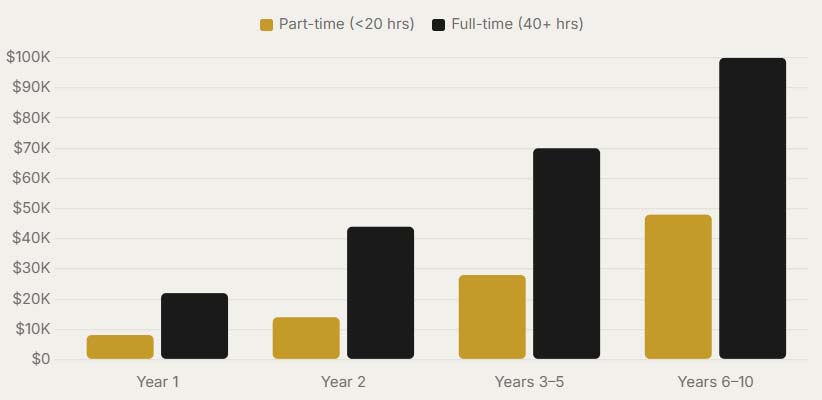
Data compiled from Jamil Academy, 2026 and NAR member surveys. Figures represent approximate medians and will vary by market and work style.
The Time Management Reality (10–15 Hours Is Enough — If You're Ruthless About It)
I want to be straight with you about something. Ten to fifteen hours a week is not a lot of time. But it is enough time — if and only if you treat every one of those hours like it costs you something, because it does. You're trading sleep, weekends, evenings. That has to mean something.
The biggest mistake new part-time agents make is spending their limited hours on tasks that feel productive but don't actually move the needle. Re-designing your business cards for the third time. Watching YouTube videos about lead gen instead of actually making calls. Obsessing over your website when you have zero clients to send to it.
Here's how I'd structure a 12-hour week that actually builds momentum:
- 3 hours — prospecting and follow-up
- This is non-negotiable and it goes first, before anything else. Call your sphere. Text your warm leads. Follow up on anyone who's gone quiet. The pipeline is the business. Everything else supports it. Set a specific block — Tuesday evenings, 7–9 PM, whatever — and treat it like a meeting you can't cancel on yourself.
- 3 hours — showings and client meetings
- This is where weekends become your best asset. Saturday afternoon showings. Sunday open houses you volunteer to host. You don't need to be available Monday at 2 PM — you need to be consistent and responsive within the windows you have. Set clear communication expectations with clients upfront, and most reasonable people will work with your schedule.
- 3 hours — learning and market knowledge
- Know your market better than agents who have been doing this for years. Read the MLS data. Track which neighborhoods are moving. Understand the new mortgage rate environment and what it means for buyers right now. This is what you bring to conversations that makes people trust you even before you've closed your first deal.
- 3 hours — content and visibility
- One piece of useful local content per week. That's it. A short video about a neighborhood. A post breaking down what first-time buyers actually need to know right now. A quick walkthrough of a listing. Consistency over time builds more trust than any single viral moment. Three hours is plenty if you batch it and stop overthinking.
The key is protecting these blocks like they're client appointments. They are. The client is your future self.
Low-Cost Lead Gen That Doesn't Require a Marketing Budget
Here's something the real estate industry doesn't always advertise: the highest-converting leads you will ever get are not the ones you buy from Zillow. They're the ones that come from people who already trust you. The problem is, most new agents treat their personal network like a source of embarrassment rather than a source of business.
I get it. Nobody wants to feel like they're selling to their friends. But there's a difference between spamming your contacts with "I'm now a REALTOR® please use me!" and actually being a useful, knowledgeable resource that people think of when real estate comes up. The second one is a long game, and it works.
Hyper-local networking — the underrated goldmine
Pick three neighborhoods you want to own. Not all of San Diego. Three zip codes, three specific communities. Learn everything. Attend the local HOA meetings. Know the school district changes. Know which listings sat too long and why. When someone in your life is considering a move in those areas, you should be the first person they think of because you've positioned yourself as the person who actually knows.
This takes time, not money. Time is the one thing you actually have, even if it's limited.
Social media authority — done the right way
I'm not talking about posting "Happy Monday!" graphics with your headshot. I'm talking about genuinely useful content that makes someone's life easier. A reel showing the actual process of making an offer in your state. A post explaining what "contingent" really means in plain English. A short video tour of a neighborhood with real talk about what it's actually like to live there — commute times, coffee shop situation, whether it floods in March.
This kind of content compounds. Something you post today might be the reason someone calls you eight months from now. And unlike paid ads, it doesn't stop working the moment your budget runs out.
Referral relationships with other professionals
Find the people who talk to your potential clients before you do. Mortgage brokers. Divorce attorneys. Estate lawyers. HR directors at companies that relocate employees. Financial planners who work with young professionals. One strong relationship with a good mortgage lender who sends you two buyers a quarter is worth more than five hundred Instagram followers.
|
✓ |
Action Step |
|---|---|
|
✓ |
Introduce yourself to at least one new professional referral contact per week |
|
✓ |
Send a genuinely useful article or market update to your sphere monthly — not a newsletter template, something real |
|
✓ |
Host one small local event per quarter (even a coffee meetup for first-time buyer questions counts) |
|
✓ |
Comment meaningfully on local community Facebook groups or Nextdoor — not to sell, but to be helpful |
|
✓ |
Ask every satisfied client for a Google review immediately after closing, while the feeling is fresh |
The Bridge Strategy: When and How to Make the Jump
This is the part people get wrong most often, and it's the part that matters most. Going full-time too early — before you have consistent income and a real pipeline — is one of the fastest ways to wash out of the industry. I've seen it happen. The desperation is palpable, clients can feel it, and it becomes a self-fulfilling spiral.
But staying part-time too long has its own cost. At some point, the deals you're losing because you can't take a Tuesday afternoon showing or respond fast enough in a hot market start to outweigh the safety of your day job income.
The bridge strategy is about hitting specific, defined benchmarks before you make the move — not crossing your fingers and hoping it works out.
NAR data shows median income for agents in years 0–2 is just $8,100 — but jumps to around $30K by years 3–5 and roughly $70K by years 6–15.
Consistency, not talent, is the variable.
The three benchmarks before you go full-time
1. Six months of living expenses in savings
Not real estate savings. Not your commission income from the last deal. Cash in a savings account that isn't going anywhere. Real estate income is lumpy — you might close three deals in one month and zero the next two. That buffer isn't optional. It's the thing that keeps you from taking bad deals or making panicked decisions when things slow down.
2. A pipeline with at least 3 active clients
Not "people who said maybe." Not a cousin who might sell in a year. Three real people who are actively working with you toward a transaction. That means you have something coming in even if one falls apart, which some always do. Going full-time with zero active pipeline is not a leap of faith — it's just a leap.
3. At least two closed transactions under your belt
You need to have done the thing. You need to know how a deal actually falls apart and gets put back together at 11 PM the night before closing. You need the reps. Two closings give you that minimum floor of experience and, importantly, give you real testimonials and a track record that means something to the next client you talk to.
The income benchmark, per data compiled in 2026, is typically when your part-time real estate earnings start reliably covering your essential monthly expenses — not everything, but housing, food, insurance. That's the inflection point where the math starts favoring the jump.
According to US Realty Training, the part-time model works best as a transition vehicle — a way to build a real pipeline before you need it to pay your rent. That framing matters. You're not dabbling. You're building a runway.
What Nobody Tells You About the Part-Time Grind
I want to be real with you about a few things that don't show up in the polished version of this story.
It is genuinely hard to be responsive enough to compete in a fast-moving market when you're working limited hours. In some hyper-competitive markets, the agent who can take a showing at 2 PM on a Wednesday will always have an advantage over the one who can't. You have to be honest with yourself about what markets and client types fit your schedule, and you have to be upfront with clients about your availability. The agents who fail at this aren't the ones who don't work hard enough — they're the ones who overpromise and underdeliver because they're trying to pretend they're full-time when they're not.
The answer isn't to hide your situation. It's to choose clients and transactions where your schedule works. First-time buyers who have flexibility. Investors who operate on a longer timeline. Sellers in a market where the pace of sales gives you time to properly respond.
And the other thing worth saying: Luxury Presence noted in their 2026 analysis that agents working fewer than 20 hours a week commonly earn under $25,000 annually — but that a small percentage hit six figures by running tight systems and focusing on referrals. That gap isn't talent. It's structure. The agents who make six figures part-time are not superhuman. They just treat their limited hours with ruthless intentionality and built their business around relationships, not cold outreach.
You can be in that group. But it requires being honest about what you're building and disciplined about how you build it.
A Realistic Timeline: What the First Two Years Can Look Like
Here's a rough framework for what this path can realistically look like if you're starting from scratch with about 12–15 hours a week.
M1- Months 1–3: Foundation
Get licensed. Choose your brokerage carefully — you want one with good training and a broker-in-charge who's actually available to you. Introduce yourself to everyone you know. Not to sell, but to let them know what you do. Start your market knowledge habit. Don't expect to close anything yet. This period is about building the base.
M2- Months 4–9: First Transactions
This is where the work you did in the first three months starts to convert. Your first client is probably someone from your sphere or a referral. Take care of them like your career depends on it — because it does. One great experience generates three referrals if you ask. Use every transaction to learn and to build your testimonial bank.
M3- Months 10–18: Building Real Momentum
By this point, you should have 2–4 closings behind you and a growing referral network. Your content is starting to build an audience. You're getting calls from people who found you through someone else. Start tracking your metrics seriously — lead sources, conversion rates, average days to close. This data tells you where to double down.
M4- Month 18–24: Evaluate the Bridge
Hit the three benchmarks we talked about — savings, active pipeline, closings — and have an honest conversation with yourself about whether the math works. For some people, this happens faster. For most, it's closer to two years. Either timeline is fine. The goal is to make the leap with a floor, not a prayer.
According to McKissock Learning's 2026 survey data, 62% of full-time agents are earning between $75,000 and $200,000 — but most of them didn't get there by going all-in on day one. They built it. You can too, and you don't have to risk everything to start.
The Bottom Line
The narrative that you have to jump in with both feet or you're not serious is wrong, and it's kept a lot of good people from ever starting. The real estate industry rewards consistency and relationships over a long period — and that's actually good news for someone building part-time, because neither of those things requires you to be available at 2 PM on a Tuesday.
What it does require: showing up every week with your limited hours, being ruthless about where you spend them, being honest with your clients about your availability, and having a real plan for the transition instead of crossing your fingers and hoping the commission income materializes.
This is a business. Treat it like one, even when it's a side one, and the path to full-time becomes a lot clearer — and a lot less terrifying.